Farewell to Yugoslavia: A Journey Through the Former SFRY
I recently read Farewell to Russia: A Journey Through the Former USSR by journalist and former Oxford researcher Joe Luc Barnes. Inspired by the book, I published a post sharing interesting facts, cultural highlights and travel trivia about each of the fifteen countries that emerged from the dissolution of the Soviet Union. Today, I’m continuing that journey by turning to the former Yugoslavia and the seven countries that emerged after its breakup. Despite their proximity to Greece, I have yet to visit any of these countries.
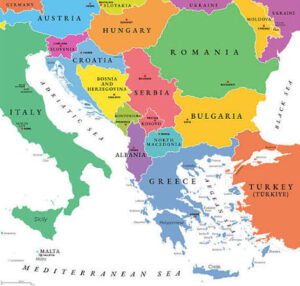
Farewell to the Socialist Federal Republic of Yugoslavia
Before exploring Yugoslavia’s successor states, it is worth briefly looking at the history of Yugoslavia itself and how it came to an end. As a sovereign state, Yugoslavia existed from 1918 to 1992. It was established after the First World War as the Kingdom of Serbs, Croats and Slovenes, uniting the Kingdom of Serbia with the provisional State of Slovenes, Croats and Serbs. This marked the first sovereign union of the South Slavic peoples after centuries of Ottoman and Habsburg rule. Over the next 74 years, the country underwent several constitutional changes and name changes, finally becoming the Socialist Federal Republic of Yugoslavia (SFRY) in 1963.
The SFRY consisted of six constituent republics: Bosnia and Herzegovina, Croatia, Macedonia, Montenegro, Serbia and Slovenia. Within Serbia were the two autonomous provinces of Kosovo and Vojvodina.
From 1944 until his death in 1980, Yugoslavia was led by Josip Broz Tito, first as prime minister and later as president. After his death, mounting economic difficulties, political instability and the rise of nationalism fuelled ethnic tensions, ultimately leading to the country’s dissolution. The republics gradually declared independence, triggering the Yugoslav Wars. Serbia and Montenegro initially remained together as the Federal Republic of Yugoslavia, which itself dissolved in 2006 when Montenegro became independent. Kosovo declared independence in 2008, although its status remains disputed by Serbia and a number of other countries.
Before we explore Yugoslavia’s seven successor states, let’s first take a closer look at Yugoslavia itself in its final years, just before it disappeared from the map.
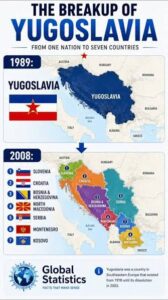
The former Socialist Federal Republic of Yugoslavia
(at the time of its dissolution)
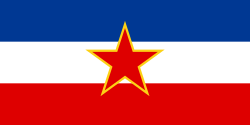
| Capital city | Belgrade |
| Biggest city | Belgrade |
| Population | 23.5 million people |
| Land area | 255,804 km² |
| Official language(s) | There was no single official language at the federal level. In practice, Serbo-Croatian was the most widely used language, alongside Slovene and Macedonian, with other minority languages enjoying official status in certain regions. |
| Predominant religions | A religiously diverse country: Eastern Orthodox Christianity (mainly in Serbia, Montenegro and Macedonia), Roman Catholicism (Croatia and Slovenia), and Islam (especially in Bosnia and Herzegovina and Kosovo). |
| Regime | A socialist federal republic governed for most of its existence by the League of Communists of Yugoslavia under a one-party system. It began transitioning toward multi-party democracy in 1990–91. |
| Participation in the World Cup | The former Socialist Federal Republic of Yugoslavia was a regular World Cup participant, qualifying eight times (1930, 1950, 1954, 1958, 1962, 1974, 1982 and 1990). Its best performance came in 1930 and 1962, when it reached the semi-finals and finished fourth. |
| Participation in the Eurovision Song Contest | Participated from 1961 to 1992, making it the only socialist country (apart from its successor states) to compete regularly in Eurovision during the Cold War. |
| Highest Eurovision result | 🥇 Winner (1989) – Rock Me by Riva. The victory led to the 1990 contest being hosted in Zagreb. |
| Must-try food | Ćevapi – grilled minced meat sausages traditionally served with flatbread, onions and ajvar, enjoyed throughout the former Yugoslavia. |
| Official/Flag carrier airline | JAT Yugoslav Airlines, the national airline from 1947 until the breakup of the country. |
| Fun fact | Yugoslavia was a founding member of the Non-Aligned Movement, pursuing an independent path between the Western and Soviet blocs during the Cold War under the leadership of Josip Broz Tito. It was also unique among socialist states in allowing relatively free travel abroad for its citizens. |
Bosnia and Herzegovina
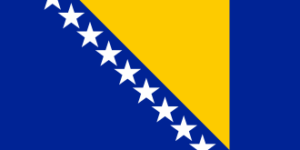
| Capital city | Sarajevo (275,000 people) |
| Biggest city | Sarajevo |
| Population | 3.2 million people |
| Land area | 51,209 km² |
| Official language(s) | Bosnian, Croatian, Serbian |
| Predominant religions | Islam (largest), alongside Orthodox Christianity and Roman Catholicism |
| Regime | Parliamentary republic |
| Currency | Bosnia and Herzegovina convertible mark (BAM)
1 euro ≈ 1.95 BAM |
| Participation in international organisations | EU: Candidate
NATO: No |
| Participation in the FIFA World Cup | Twice (2014, 2026) |
| Best World Cup result | Round of 32 (2026) |
| Participation in the Eurovision Song Contest | Since 1993 |
| Highest Eurovision result | 3rd place (2006) – Lejla by Hari Mata Hari |
| Must-try food | Ćevapi – grilled minced meat served with flatbread and onions |
| Official/flag carrier airline | None |
| Fun fact | Bosnia and Herzegovina’s distinctive heart-shaped outline has earned it the nickname “the heart-shaped land.” |
Croatia
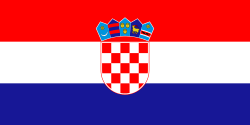
| Capital city | Zagreb (770,000 people) |
| Biggest city | Zagreb |
| Population | 3.8 million people |
| Land area | 56,594 km² |
| Official language(s) | Croatian |
| Predominant religions | Roman Catholic Christianity |
| Regime | Parliamentary republic |
| Currency | Euro |
| Participation in international organisations | EU: Since 2013
NATO: Since 2009 |
| Participation in the FIFA World Cup | 7 times (1998, 2002, 2006, 2014, 2018, 2022, 2026) |
| Best World Cup result | Runner-up (2018); also 3rd place (1998, 2022) |
| Participation in the Eurovision Song Contest | Since 1993 |
| Highest Eurovision result | 2nd place (2024) – Rim Tim Tagi Dim by Baby Lasagna |
| Must-try food | Peka – meat or seafood cooked under a bell-shaped lid |
| Official/flag carrier airline | Croatia Airlines |
| Fun fact | Croatia is home to over 1,200 islands, although only around 50 are permanently inhabited. |
Kosovo
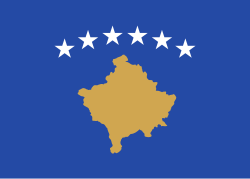
| Capital city | Pristina (230,000 people) |
| Biggest city | Pristina |
| Population | 1.6 million people |
| Land area | 56,594 km² |
| Official language(s) | Albanian, Serbian |
| Predominant religions | Islam (majority), with Christian minorities |
| Regime | Parliamentary republic |
| Currency | Euro – Although they’re not members of the EU, Kosovo and Montenegro use the euro unilaterally. They previously used the German Mark before switching over when the euro launched. |
| Participation in international organisations | EU: No
NATO: No |
| Participation in the FIFA World Cup | Never. Kosovo has been a FIFA member since 2016 but has not yet qualified for a World Cup. |
| Best World Cup result | N/A |
| Participation in the Eurovision Song Contest | Has never participated (not an EBU member). |
| Highest Eurovision result | N/A |
| Must-try food | Flija – a traditional layered pancake-like dish. |
| Official/flag carrier airline | None |
| Fun fact | Kosovo is one of Europe’s youngest countries, having declared independence in 2008. After Kosovo unilaterally declared its independence from Serbia, it has gained diplomatic recognition by at least 110 member states of the United Nations. Serbia, however, does not officially recognise Kosovo as a sovereign state. |
Montenegro
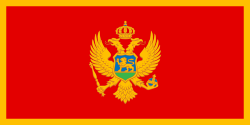
| Capital city | Podgorica (190,000 people) |
| Biggest city | Podgorica |
| Population | 620,000 people |
| Land area | 13,812 km² |
| Official language(s) | Montenegrin |
| Predominant religions | Eastern Orthodox Christianity |
| Regime | Parliamentary republic |
| Currency | Euro – Although they’re not members of the EU, Montenegro and Kosovo use the euro unilaterally. They previously used the German Mark before switching over when the euro launched. |
| Participation in international organisations | EU: Candidate
NATO: Since 2017 |
| Participation in the FIFA World Cup | Never |
| Best World Cup result | N/A |
| Participation in the Eurovision Song Contest | Since 2007 |
| Highest Eurovision result | 13th place (2015) – Adio by Knez |
| Must-try food | Kačamak – creamy cornmeal with cheese and potatoes. |
| Official/flag carrier airline | None |
| Fun fact | Despite its name meaning “Black Mountain”, Montenegro boasts a spectacular Adriatic coastline. |
North Macedonia
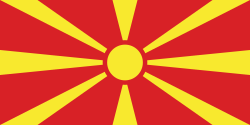
| Capital city | Skopje (530,000 people) |
| Biggest city | Skopje |
| Population | 1.8 million people |
| Land area | 13,812 km² |
| Official language(s) | Macedonian – an Eastern South Slavic language, not to be confused with the Ancient Macedonian language (a Hellenic language spoken by the ancient Macedonians during the 1st millennium BC). As part of the South Slavic dialect continuum, Macedonian shares a high degree of mutual intelligibility with Bulgarian and, to a lesser extent, with the Serbo-Croatian language varieties. The Bulgarian government, the Bulgarian Academy of Sciences, and many Bulgarian scholars regard Macedonian as part of the Bulgarian dialect continuum. |
| Predominant religions | Eastern Orthodox Christianity, with a significant Muslim minority |
| Regime | Parliamentary republic |
| Currency | Macedonian denar (MKD)
1 euro ≈ 61.5 MKD |
| Participation in international organisations | EU: Candidate
NATO: Since 2020 |
| Participation in the FIFA World Cup | Never |
| Best World Cup result | N/A |
| Participation in the Eurovision Song Contest | Since 1998 |
| Highest Eurovision result | 7th place (2019) – Proud by Tamara Todevska |
| Must-try food | Tavče gravče – baked beans seasoned with paprika |
| Official/flag carrier airline | None |
| Fun fact | Lake Ohrid is one of Europe’s oldest and deepest lakes. |
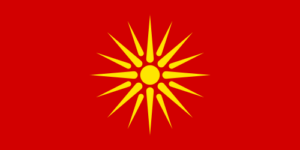
Macedonia name dispute
Following the breakup of Yugoslavia in 1991, a long-running dispute emerged between Greece and the newly independent Republic of Macedonia over the use of the name “Macedonia”. The disagreement stemmed from the shared historical and geographical associations of the term, which refers not only to the former Yugoslav republic but also to the neighbouring Greek region of Macedonia and the ancient Kingdom of Macedon.
At the end of the Second World War, the name “Macedonia” was adopted by the Socialist Republic of Macedonia, one of the six constituent republics of the Socialist Federal Republic of Yugoslavia. When Yugoslavia dissolved, this republic declared independence in 1991 under the name “Republic of Macedonia”.
Greece objected to the use of the name without a geographical qualifier such as “North” or “Upper”, arguing that it could imply territorial claims over the Greek region of Macedonia and appropriate a historical and cultural heritage closely associated with Greece. Greece also opposed the country’s use of symbols and historical figures that it regarded as part of Greek history, including the Vergina Sun and Alexander the Great.
Pending a resolution, many international organisations and countries referred to the state by the provisional designation “the former Yugoslav Republic of Macedonia” (FYROM). The dispute was formally resolved in 2018 with the signing of the Prespa Agreement, under which the country adopted the official name “Republic of North Macedonia”.
Serbia
| Capital city | Belgrade (1.4 million people) |
| Biggest city | Belgrade |
| Population | 6.6 million people |
| Land area | 77,474 km² (excluding Kosovo) |
| Official language(s) | Serbian |
| Predominant religions | Eastern Orthodox Christianity |
| Regime | Parliamentary republic |
| Currency | Serbian dinar (RSD)
1 euro ≈ 117.4 RSD |
| Participation in international organisations | EU: Candidate
NATO: No |
| Participation in the FIFA World Cup | 3 times (2010, 2018, 2022) |
| Best World Cup result | Group stage |
| Participation in the Eurovision Song Contest | Since 2007 |
| Highest Eurovision result | 1st place (2007) – Molitva by Marija Šerifović |
| Must-try food | Pljeskavica – often described as the Balkan burger. |
| Official/flag carrier airline | Air Serbia |
| Fun fact | Serbia won Eurovision on its debut as an independent country in 2007. |
Slovenia
| Capital city | Ljubljana (300,000 people) |
| Biggest city | Ljubljana |
| Population | 2.1 million people |
| Land area | 20,271 km² |
| Official language(s) | Slovene |
| Predominant religions | Roman Catholic Christianity |
| Regime | Parliamentary republic |
| Currency | Euro |
| Participation in international organisations | EU: Since 2004
NATO: Since 2004 |
| Participation in the FIFA World Cup | Twice (2002, 2010) |
| Best World Cup result | Group stage |
| Participation in the Eurovision Song Contest | Since 1993 |
| Highest Eurovision result | 7th place (1995) – Prisluhni mi by Darja Švajger and 7th place (2001) – Energy by Nuša Derenda |
| Must-try food | Kranjska klobasa – Slovenia’s famous smoked sausage. |
| Official/flag carrier airline | None (following the collapse of Adria Airways) |
| Fun facts | Nearly 60% of Slovenia is covered by forest, making it one of Europe’s greenest countries.
Slovenia was represented at the 2019 Eurovision Song Contest by the duo Zala Kralj and Gašper Šantl with the understated indie-pop ballad Sebi, my favourite Eurovision song from any of these six countries. Performed with an intimate staging that focused on the chemistry between the two singers, the entry stood out for its simplicity and authenticity, finishing 15th in the Grand Final. |
Alex
(the Traveling Psychiatrist)