A trip to Lyon, the gastronomic capital of France
Lyon is the third-largest city in France and one of the country’s most important cultural and economic centres. Located in the Auvergne-Rhône-Alpes region, it lies at the confluence of the Rhône and Saône rivers and has a population of nearly 520,000. For centuries, Lyon has been a centre of trade, agriculture, and culinary excellence, giving rise to one of France’s richest and most distinctive gastronomic traditions. Often regarded as the gastronomic capital of France, Lyon has a culinary reputation that extends far beyond the country’s borders. Whether in Michelin-starred establishments or traditional neighbourhood eateries, food is central to Lyon’s identity and daily life.
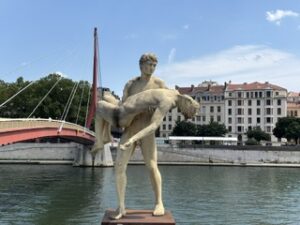
As both a foodie and a passionate traveller, I finally visited Lyon for the first time this year. The city more than lived up to its reputation, and I’d love to share some of the places, flavours, and experiences that made my trip so memorable.
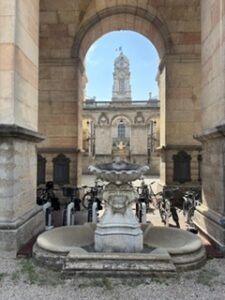
What and where to eat in Lyon
Try the traditional Lyonnaise cuisine in a bouchon
Lyonnaise cuisine is most famously experienced in a bouchon, the traditional restaurants that are unique to Lyon and form the heart of the city’s culinary identity. Bouchons originated as modest eateries serving silk workers and local craftsmen, and they remain known for their warm, convivial atmosphere, checkered tablecloths, generous portions, and deeply traditional cooking.
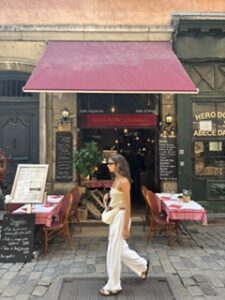
The cuisine celebrates regional produce and the philosophy of using every part of the animal, resulting in dishes that are robust, flavourful, and unapologetically rich.
A classic meal might begin with salade lyonnaise, a salad of frisée lettuce topped with crispy lardons, croutons, and a poached egg, followed by quenelles de brochet, delicate pike dumplings baked in a creamy Nantua sauce made with crayfish.
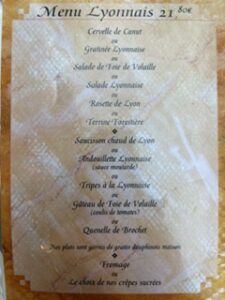
Other emblematic bouchon dishes include andouillette, a coarse sausage made from pork intestines with a distinctive flavour; tablier de sapeur, strips of tripe marinated, breaded, and fried; saucisson chaud (poached sausage); cervelle de canut, a fresh cheese seasoned with herbs, shallots, vinegar, and olive oil; and gratin dauphinois or buttery potatoes served alongside slow-cooked meats.
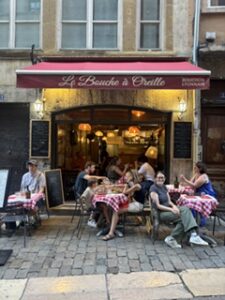
Meals are often accompanied by local wines from the nearby Beaujolais and Côtes du Rhône vineyards, reinforcing the close relationship between Lyon’s cuisine and the surrounding agricultural regions.
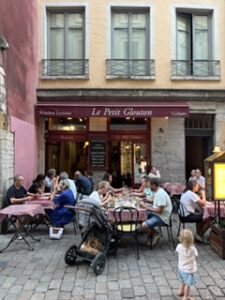
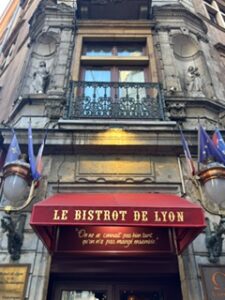
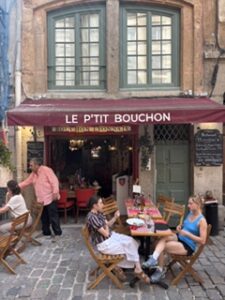
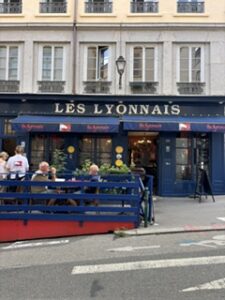
If you’re looking to experience traditional Lyonnaise cuisine, I’d highly recommend Le Petit Glouton in Vieux Lyon, tucked away next to La Longue Traboule behind the Cour d’Appel de Lyon, and Le Bistrot de Lyon in the Presqu’île. Both are excellent examples of authentic bouchons lyonnais, serving classic regional dishes in a warm, convivial atmosphere.
Visit Les Halles Paul Bocuse
Les Halles Paul Bocuse, Lyon’s celebrated indoor gourmet food market, is named after the legendary chef Paul Bocuse. It is home to some of the city’s finest cheeses, charcuterie, pastries, chocolates, and regional delicacies.
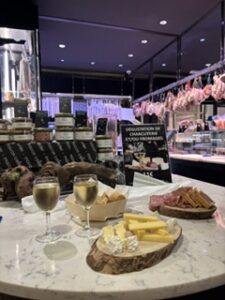
For a relaxed wine-and-cheese experience, I’d recommend Cellelier, where you can enjoy a glass of wine with a cheese platter (dégustation de fromages) or a charcuterie platter (dégustation de charcuterie) for just €11. It’s an excellent value and a perfect way to sample some of the region’s finest cheeses and cured meats.
What and where to have dessert in Lyon
Lyon also has a distinctive dessert tradition that is often overshadowed by its savoury dishes. The city’s most famous sweet speciality is the tarte à la praline, made with les pralines roses de Lyon, the region’s characteristic bright pink pralines—almonds coated in caramelised sugar—which are baked into a rich cream filling that gives the tart its striking crimson colour.
Lyon is also renowned for its artisanal chocolates and confectionery, particularly coussins de Lyon, emerald-green marzipan sweets filled with chocolate ganache and orange liqueur, whose shape is inspired by a silk cushion associated with a local religious tradition.
These desserts reflect the same values that define Lyonnaise cuisine as a whole: high-quality ingredients, regional identity, and a balance between rustic simplicity and refined craftsmanship.
Lyon is filled with excellent pâtisseries, from neighbourhood bakeries to the renowned food stalls of Les Halles Paul Bocuse. Voisin is one of the city’s most famous chocolatiers and pastry shops, and it was there that I had my first taste of Lyon’s iconic pink pralines, one of the city’s most distinctive sweet specialities.
Traditional bouchons frequently serve simple but excellent desserts such as île flottante (poached meringue on vanilla custard), crème brûlée, riz au lait (rice pudding), or clafoutis made with seasonal fruit. At Le Petit Glouton, I ended my meal with a sweet crêpe flavoured with Grand Marnier, while at Le Bistrot de Lyon I chose a crème brûlée with pink praline, a delicious local twist on the classic French dessert. Both were memorable in their own way and perfectly captured Lyon’s love of indulgent, traditional flavours.
Where to have ice cream in Lyon
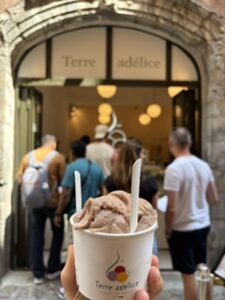
If you’re in the mood for an ice cream, I would recommend Terre adélice, an ice cream parlour in Vieux Lyon. There’s always a queue outside—and for good reason. The selection of ice cream and sorbet flavours is enormous, possibly the largest I’ve ever come across. During my visit, I tried the chocolate sorbet, purple fig, and quince, all of which were excellent. There are also tables if you’d prefer to eat in; seated customers join a separate queue, which is often shorter than the one for takeaway.
Bruno Saladino is a charming chocolatier in Vieux Lyon. I stopped by for one of their ice cream desserts and chose the apricot sorbet. The desserts are pre-prepared and beautifully presented.
What (else) to do in Lyon
Of course, there is far more to Lyon than its restaurants. The city is rich in history, architecture, and culture, and the itinerary below is the one I followed during my visit.
Wander around Vieux Lyon
Vieux Lyon, the city’s UNESCO-listed Old Town, is renowned for its beautifully preserved Renaissance architecture, narrow cobbled streets, colourful facades, and atmospheric courtyards. I spent many hours simply wandering through this part of the city, letting myself get pleasantly lost among its streets, squares, and riverside walkways.
Visit the Saint-Jean Cathedral
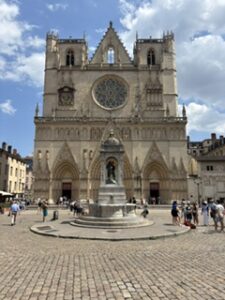
One of the main sights in Vieux Lyon is the Saint-Jean Cathedral (Cathédrale Saint-Jean). This magnificent Gothic cathedral was built between the 12th and 15th centuries, and is famous for its ornate façade and remarkable astronomical clock, which still performs mechanical displays.
Explore the traboules of Vieux Lyon
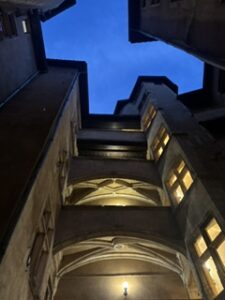
While exploring Vieux Lyon, make sure to visit at least one of the city’s famous traboules. I visited several, including La Longue Traboule. Aptly named for its unusually long passageway, this traboule is located next to Le Petit Glouton behind the Cour d’Appel de Lyon, which is housed in the neoclassical Palais de Justice Historique de Lyon, commonly known as the “Palace of the 24 Columns” (Palais des 24 Colonnes). Traboules are a fascinating network of hidden covered passageways that connect streets, courtyards, and buildings. They were originally used by Lyon’s silk merchants to transport fabrics through the city while protecting them from the weather, and many later served as secret routes for members of the French Resistance during the Second World War.
Visit the Basilica of Notre-Dame de Fourvière
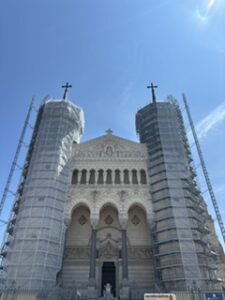
Make sure you take the funicular to the Basilica of Notre-Dame de Fourvière (Basilique Notre-Dame de Fourvière). This is Lyon’s most iconic landmark, perched on Fourvière Hill, with richly decorated interiors and spectacular panoramic views over the city and the surrounding Alps on clear days.
Visit the Ancient Theatre of Fourvière
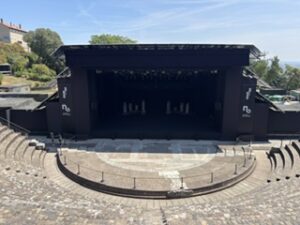
Afterwards, walk to the Ancient Theatre of Fourvière. This is an impressive Roman amphitheatre dating back to the 1st century BC, which still hosts concerts and performances during the annual Nuits de Fourvière festival.
Wander around Presqu’île
The part of Lyon between the Rhône and Saône rivers is called the Presqu’île, which means “almost an island” or peninsula. Framed by the Saône on the west and the Rhône on the east, it stretches from the foot of the Croix-Rousse hill down to where both rivers meet. It is home to some of the city’s most famous squares and sights.
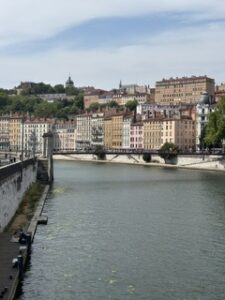
Place Bellecour
One of Europe’s largest pedestrian squares and the symbolic heart of Lyon, Place Bellecour is dominated by the equestrian statue of Louis XIV and surrounded by elegant 19th-century buildings, cafés, and shopping streets.
Place des Jacobins
Place des Jacobins is one of Lyon’s most elegant squares. It is best known for the ornate 19th-century Jacobins Fountain, surrounded by grand Haussmann-style buildings, cafés, and restaurants, making it a popular meeting point and one of the city’s most picturesque public spaces.
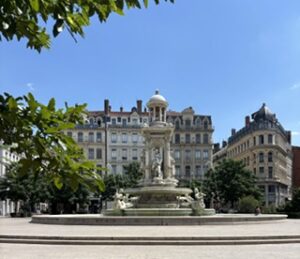
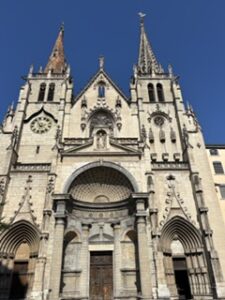
Saint Nizier Church
The Church of Saint-Nizier (Église Saint-Nizier) is situated between the Place des Terreaux and the Place des Jacobins. Its name refers to Nicetius of Lyon, a bishop of the city during the 6th century. Begun in the 14th century and only completed in the 19th century, the church contains a variety of architectural styles, ranging from the neo-Gothic spire to the classical Renaissance facade. In 1998, it was inscribed on the UNESCO World Heritage List along with other historic buildings in Lyon.
Place des Terreaux and the Museum of Fine Arts
Place des Terreaux is a grand historic square featuring the ornate Bartholdi Fountain, the impressive City Hall, and the Museum of Fine Arts (Musée des Beaux-Arts de Lyon), making it one of the city’s most elegant public spaces.
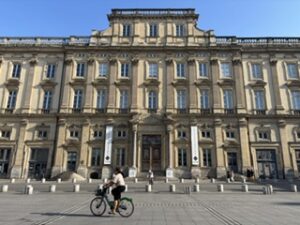
Known as Hôtel de Ville de Lyon, the city’s magnificent 17th-century City Hall is renowned for its richly decorated Baroque façade and ornate ceremonial interiors.
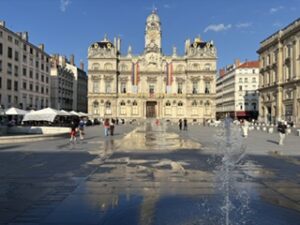
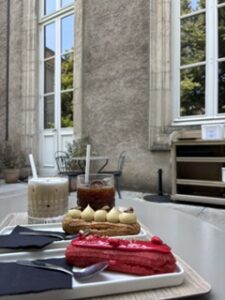
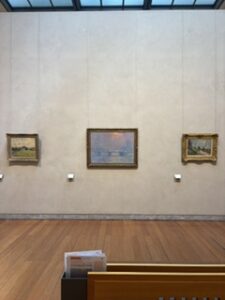
Next to it, housed in a magnificent 17th-century former Benedictine abbey overlooking Place des Terreaux, the Museum of Fine Arts of Lyon is one of France’s finest art museums. The museum’s elegant cloisters and peaceful garden provide a beautiful setting. The permanent exhibitions span more than five millennia, ranging from ancient Egyptian, Greek, and Roman antiquities to Renaissance masterpieces, French and European paintings, sculpture, decorative arts, and an outstanding collection of 19th- and 20th-century works, including pieces by artists such as Monet, Manet, Renoir, Cézanne, Degas, Gauguin, Sisley, Pissarro, Picasso, and Matisse. There’s also a painting by El Greco (Le Greco in French). The café of the museum, located within the former abbey complex, is a charming spot to relax after exploring the collections. I had a delicious éclair with pink praline.
Opéra National de Lyon
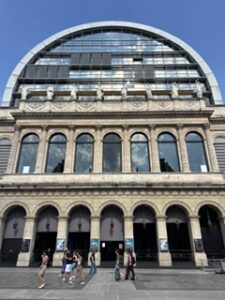
On the opposite side of the City Hall, there’s the Opéra National de Lyon. It is a striking architectural blend of old and new, where an elegant 19th-century façade is topped by a dramatic modern glass-and-steel dome designed by Jean Nouvel.
Where to have coffee in Lyon
Lyon is home to countless charming cafés, and one of the best areas for café-hopping is the Presqu’île.
From the Opéra National de Lyon, walk uphill along Rue Saint-Polycarpe, which leads to the beautiful 17th-century church of the same name. Just before reaching the church, you’ll come to a small intersection with Rue des Capucins, where cafés occupy each corner, including Nuage Café and La Boîte à Café. Continue a little further towards the Église Saint-Polycarpe, and you’ll find more inviting cafés on either side of the church, such as Kachka and La Maison Cobalte. Other excellent options nearby include Le Perko Café and À Chacun Sa Tasse, both ideal for a leisurely coffee break.
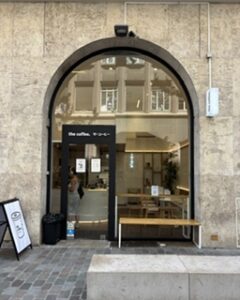
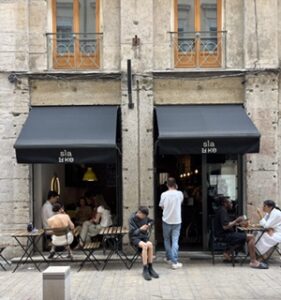
Another great café district is around Place des Jacobins. The Coffee is a cosy Japanese-style café and part of a chain I was already familiar with from a previous visit to Vienna. Nearby, Slake is another beautifully designed café that quickly became one of my favourites. If you’re near Place Bellecour, Bionda Caffè, located within the elegant Grand Hôtel-Dieu complex, is a wonderful Italian café for espresso, pastries, or an aperitif.
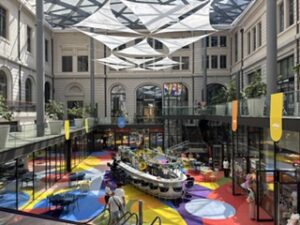
Alternatively, cross the Saône into Vieux Lyon and seek out Puzzle, a lovely café tucked away behind Saint-Jean Cathedral. What I loved most was the atmosphere: many customers were reading books rather than staring at screens. I ordered a cold brew, which turned out to be the perfect caffeine fix on a hot summer afternoon.
Where to stay in Lyon
I stayed at Best Western Crequi Lyon Part Dieu, located near Les Halles Paul Bocuse, and within walking distance of all the places mentioned above. The breakfast was very good!
How long to stay in Lyon
If you’re looking for a first taste of Lyon—pun fully intended—a couple of days is enough to explore the city’s main sights and sample its celebrated cuisine. But the longer you stay, the more opportunities you’ll have to linger in its bouchons, discover new cafés and pâtisseries, and truly appreciate why Lyon is considered the gastronomic capital of France.
Further reading
If you’ve worked an appetite for France, check out my posts about Paris, Bordeaux and Nantes:
Where to eat and drink in the 6th arrondissement of Paris
7 sweet spots in Bordeaux & Saint Émilion
Bordeaux neighbourhoods: saints, churches, wine
Top 7 tips for an unforgettable weekend in Nantes
Bon voyage!
Alex
(the Traveling Psychiatrist)