My (almost) Korean skincare routine
For several years now, I’ve been fascinated by Korean culture. I’m not particularly interested in K-pop, but I’ve been a regular attendee at London’s K-Music Festival (this year running from 28 September to 23 November). I’ve also taken every opportunity to watch Korean films, especially during the London Korean Film Festival (this year from 1 to 13 November), and I’ve become an enthusiastic viewer of K-dramas, mostly on Netflix. And, of course, I’ve long been a huge fan of Korean literature and cuisine. After visiting South Korea two years ago, my interest expanded to Korean skincare and cosmetics. What began as curiosity gradually turned into a daily habit, and I now follow an almost Korean skincare routine twice a day, morning and night.
The Korean skincare philosophy focuses on achieving healthy, hydrated “glass skin” by layering products from the lightest consistency to the richest. Although the famous 10-step routine often gets the most attention, the core principles are much simpler: double cleansing, hydration, moisturising, and sun protection.
I’ve adapted the traditional routine to suit my own skin and lifestyle.
Korean skincare – Morning routine
-
Oil-based cleanser
I begin with either UNIK Calendula Complete Cleansing Oil or MUJI Cleansing Oil.
Oil cleansers help dissolve sunscreen, excess sebum, makeup (when applicable), and other oil-based impurities that accumulate on the skin.
-
Water-based cleanser
I follow with a water-based cleanser, usually NIVEA MEN Deep Cleaning Face Wash Protect & Care.
I have also used Korean products such as COSRX Low Ph Good Morning Gel Cleanser.
This removes sweat, dirt, and water-soluble impurities left behind after the first cleanse. Water-based cleansers come in various forms, including gels, foams, and micellar waters.
-
Essence toner
Rather than using a separate toner and essence, I prefer a hybrid product: an essence toner.
A traditional toner helps restore the skin’s pH balance and provides a first layer of hydration after cleansing.
An essence focuses on deeper hydration and prepares the skin to absorb subsequent products more effectively. An essence toner combines both functions in a single step.
I currently use either SKIN1004 Madagascar Centella Probio-Cica Essence Toner or FRUDIA Avocado Relief Essence Toner.
Interestingly, I only use an essence toner in the morning. When I tried using it at night, I felt it irritated my skin.
-
Vitamin C serum
In the morning I use Purito Seoul Pure Vitamin C Serum.
Vitamin C helps brighten the complexion, reduce hyperpigmentation and dark spots, stimulate collagen production, and protect against free-radical damage caused by UV exposure and pollution.
For the next few steps, I move away from Korean skincare and use Western brands, mainly Clinique and La Roche-Posay.
-
Eye cream
The skin around the eyes is thinner and more delicate than the rest of the face, so I use Clinique For Men Anti-Age Eye Cream.
It helps with hydration, fine lines, puffiness, and dark circles.
-
Moisturiser
My daytime moisturiser is Clinique For Men Maximum Hydrator 72H.
A good moisturiser hydrates the skin, locks in moisture, and helps maintain the skin barrier.
-
Sunscreen
If I had to choose only one skincare step, it would be sunscreen.
I currently use La Roche-Posay Anthelios Hydrating Cream SPF50, after having an allergic reaction to another (non-Korean) brand.
I have also used Korean products, such as Beauty of Joseon Relief Sun : Rice + Probiotics SPF50.
Sunscreen protects against UV damage, reduces the risk of skin cancer, and helps prevent premature ageing, including wrinkles and pigmentation.
Although many moisturisers and serums contain SPF, I prefer using a dedicated facial sunscreen whenever I’m likely to spend time outdoors. In London, I’m admittedly less strict on dark winter days when I expect to be indoors most of the time.
I would recommend using SPF50 or higher.
Korean skincare – Evening routine
-
Oil-based cleanser
Same as in the morning.
-
Water-based cleanser
Same as in the morning.
-
Exfoliator (once a week)
I exfoliate only once a week, at most.
Exfoliation removes dead skin cells, smooths texture, brightens dull skin, and helps unclog pores.
I use COSRX BHA 4% Blackhead + Niacinamide 2% Exfoliant Toner.
-
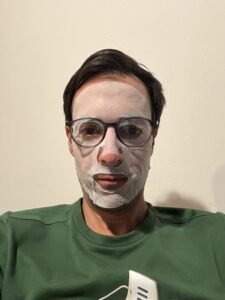
Sheet mask (once a week)
This is another weekly rather than daily step.
Sheet masks are fabric or gel masks soaked in concentrated serum. They create a temporary barrier that allows hydrating and soothing ingredients to absorb more effectively over 10–20 minutes.
I’ve tried many different brands, but most recently I’ve been using EUNYUL Purity Sheet Masks.
-
Essence
Since I found the SKIN1004 Madagascar Centella Probio-Cica Essence Toner irritating at night, I replaced it with a dedicated essence: COSRX Advanced Snail 96 Mucin Power Essence.
Snail mucin is known for its hydrating, soothing, and skin-repairing properties.
When I travel light, I also use this essence in the morning instead of an essence toner.
-
Serum
My evening serum depends on the day.
On retinol nights, I use SOME BY MI Retinol Intense Reactivating Serum.
Retinol helps improve fine lines, stimulate collagen production, accelerate cell turnover, unclog pores, and reduce pigmentation.
Retinol should only be used at night because it increases the skin’s sensitivity to sunlight.
I started by using it every evening, but I now alternate it with Beauty of Joseon Glow Serum (Propolis + Niacinamide).
Propolis has anti-inflammatory and soothing properties, while niacinamide helps regulate oil production, minimise the appearance of pores, and strengthen the skin barrier.
-
Eye cream
On retinol nights, I also use SOME BY MI Retinol Intense Advanced Triple Action Eye Cream.
-
Moisturiser
In the evening I switch to a Korean moisturiser.
Over the past few years I’ve used several, including SKIN1004 Madagascar Centella Probio-Cica Enrich Cream and Isntree Hyaluronic Acid Aqua Gel Cream.
Centella has soothing and skin-barrier-supporting properties. It can help calm irritation and redness while providing hydration, making it particularly useful for sensitive, dry, or stressed skin.
Hyaluronic acid is another one of my favourite ingredients because it attracts and retains moisture, making it especially useful for dehydrated skin.
As well as Korean moisturisers, I have also used Western ones, such as CeraVe Facial Moisturising Lotion.
When I travel light
When I travel, I simplify the routine considerably.
I usually leave behind the larger bottles, particularly my oil cleanser and essence toner.
That means I skip the oil cleanse and begin with the water-based cleanser both morning and night.
In the morning, I replace the essence toner with COSRX Advanced Snail 96 Mucin Power Essence, which works well enough for both routines.
I also leave the exfoliator at home, since I only use it once a week anyway.
Sheet masks sometimes come with me because they’re lightweight and don’t count as liquids.
I’m fully aware that this is not a traditional Korean 10-step routine, and I’m certainly not a skincare expert. It’s simply the routine that has gradually evolved through trial and error, and it has worked remarkably well for me.
Perhaps that’s the most Korean part of it: consistency, hydration, and paying attention to what your own skin is trying to tell you.
Beyond skincare products
That said, healthy skin is not just about skincare products. Adequate sleep, good nutrition, avoiding harmful substances such as tobacco and excessive alcohol, and keeping stress levels under control (through practices such as meditation, mindfulness, breathwork, or yoga) are just as important for your skin as they are for your overall physical and mental well-being.
Further reading
I recently read The Korean Book of Happiness: A journey across South Korea in pursuit of joy by Barbara Zitwer, which further sparked my interest in Korean culture and literature.
Alex
(the Traveling Psychiatrist)