24 (+1) Japanese authors to read
Japan is one of my favourite countries in the world—perhaps even my favourite. Long before I first visited Japan last year, I had been immersed in Japanese literature, reading novels by Japanese authors in translation, whether in English, Greek, or French. I even attempted a few in Italian, though I quickly discovered that my Italian is not quite up to the task—still, it is certainly better than my Japanese!
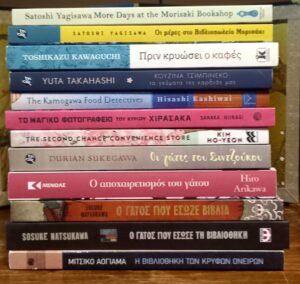
I recently logged all the books I currently own on Goodreads, along with many others I’ve read over the years. To my surprise, books by Japanese authors far outnumber those from any other country. Well, that’s not entirely true. If I include the Agatha Christie novels I’ve read—basically all her 66 mystery and crime novels—British authors come out comfortably on top. Without Christie, however, Japanese authors are the clear frontrunners, with British authors only a close second.
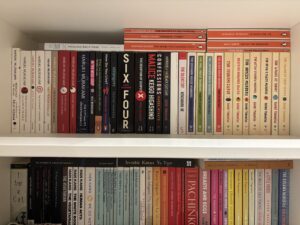
It was my fascination with Japan and its literature that led me to join the Virtual Book Club: Japanese Literature a few years ago. We meet online approximately every two months, each time discussing a different work of Japanese fiction or literature. Although I have often already read the books selected for discussion, the club has also introduced me to unexpected discoveries — new books, unfamiliar authors, and fresh perspectives on writers I thought I already knew. It has become a wonderful way to deepen my appreciation of Japanese literature while sharing the experience with fellow readers from around the world.
From tsundoku to bibliophilia
Tsundoku (not to be confused with sudoku) combines the Japanese words for ‘piling up’ (tsunde oku) and ‘reading’ (dokusho). The concept refers to the habit—or perhaps the art—of buying books and allowing them to accumulate, often in ever-growing piles, without actually getting around to reading them.
In English, tsundoku is sometimes loosely associated with terms such as ‘book-hoarding’, ‘bibliomania’ or ‘bibliophilia’, although none captures quite the same idea. I, for example, am personally guilty of book-hoarding, but I am no longer guilty of buying books and leaving them unread (there was, admittedly, a time when I was). My bookshelves may continue to multiply, but so, thankfully, does the number of books I actually read.
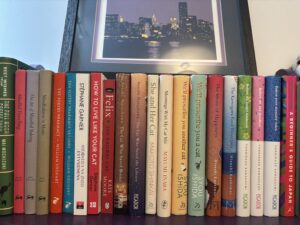
Bibliomania, on the other hand, has rather different—and historically more pathological—connotations. The word combines the Greek biblio, meaning ‘book’, with mania, meaning ‘madness’, and describes an excessive or compulsive preoccupation with acquiring or collecting books. It should not be confused with bibliophilia. Derived from biblio (‘book’) and philia (‘love’), bibliophilia simply refers to a love of books, particularly collecting and reading them. Nothing wrong with that.
Perhaps, then, tsundoku occupies its own charming space somewhere between collecting books and reading them: the optimistic belief that every unread book on the shelf is not a failure, but a pleasure patiently awaiting its turn.
24 (+1) Japanese authors to read
In this post, I discuss some of my favourite Japanese authors. My only criterion for inclusion is simple: I must have read at least two of their books.
Aoyama, Michiko
I first discovered Michiko Aoyama while browsing the Japanese section of a bookshop in France. At the time, her books had not yet been translated into English, but I was intrigued by what I found. Soon afterwards, her novel La bibliothèque des rêves secrets (The Library of Secrets) was translated into English as What You Are Looking for Is in the Library — and later into Greek — although I read it in English.
Another novel of hers, Un jeudi saveur chocolat (Thursday Chocolate), only became available in English this year, under the title Hot Chocolate on Thursday. I read it in French and thoroughly enjoyed its gentle, uplifting exploration of human connections and everyday moments of kindness. I think it would make an excellent choice for discussion at the Virtual Book Club: Japanese Literature.
Arikawa, Hiro
Hiro Arikawa is the author of The Traveling Cat Chronicles, one of my all-time favourite books—a distinction that is hardly surprising, given that it combines three things I love: cats, traveling and Japan. She has also written The Goodbye Cat, a collection of seven interconnected short stories, and The Passengers on the Hankyu Line, which was translated into English relatively recently and was one of the books I read this summer. Arikawa has a wonderful gift for finding warmth, humour, and quiet emotion in everyday encounters, which is precisely what keeps drawing me back to her work.
Ayatsuji, Yukito
As much as I love Japanese literature—and, to be honest, almost anything Japanese—I have an even greater weakness for whodunnits. You may have guessed that already when I mentioned Agatha Christie. So when I discovered Yukito Ayatsuji, I was hooked almost immediately. Ayatsuji is a Japanese crime writer who has published more than thirty novels, and so far I’ve read The Decagon House Murders, The Mill House Murders, The Labyrinth House Murders, and The Clock House Murders. His novels are among the most ingenious and satisfying murder mysteries I’ve ever read, and I’m dying to work my way through the rest of his books.
Endo, Shusaku
Shūsaku Endō is the author of Silence, the acclaimed novel that was adapted into a film by Martin Scorsese and starred Andrew Garfield, Liam Neeson, and Adam Driver — an outstanding cast. The film was released in 2016, and I watched it shortly after its premiere. It was only years later, however, that I finally turned to Endō’s original novel.
Around the same time, I discovered another of his works, Scandal, while browsing my parents’ bookcase — of all places. The book had been quietly sitting there, most likely for decades, waiting to be rediscovered. I was fascinated to find a Japanese novel translated into Greek long before I — and much of the world — became captivated by Japanese literature. Naturally, I picked it up and read it immediately.
Higashino, Keigo
Keigo Higashino sadly passed away in July 2026 at the age of 68. I only discovered his work recently through the Virtual Book Club: Japanese Literature, where The Devotion of Suspect X was the novel we discussed at our April meeting. First published in 2005, it is a brilliantly constructed mystery novel and the first book in his acclaimed Detective Galileoseries. Higashino was one of Japan’s most prolific and celebrated crime writers, publishing more than a hundred books during his career, with many translated into English and adapted for film and television. Following his passing, I read Malice, which I enjoyed even more than The Devotion of Suspect X.
Ichida, Syou
Syou Ishida is the author of a series that appealed to me for several reasons. Not only are the books set in Japan and filled with cats, but they also explore the healing power of the human-animal bond. As a psychiatrist, I could hardly resist that premise. So far, I’ve read We’ll Prescribe You a Cat and We’ll Prescribe You Another Cat, and I’m already looking forward to the next instalment, Welcome to the Kokoro Cat Clinic.
Each book consists of four or five interconnected stories centred on the mysterious Nakagyō Kokoro Clinic for the Soul, tucked away on the top floor of an old building at the end of a narrow cobbled alley in Kyoto. In each chapter, a different patient arrives at the clinic with an emotional burden, and the enigmatic doctor prescribes an unusual form of treatment: a cat. The result is a series of gentle, comforting, and quietly profound stories about loneliness, grief, hope, and the unexpected ways in which animals can help us heal.
Ishiguro, Kazuo
Three Japanese authors have won the Nobel Prize in Literature: Yasunari Kawabata (1968), Kenzaburō Ōe (1994), and Kazuo Ishiguro (2017). Although Ishiguro was born in Nagasaki, he is a British author who writes in English. He has published eight novels, of which I have read three: An Artist of the Floating World, The Remains of the Day, and Never Let Me Go. All three have been adapted into acclaimed films, a testament to the enduring power and emotional depth of his writing.
Kashiwai, Hisashi
Like Syou Ishida and several other authors on this list, Hisashi Kashiwai has written a series of interconnected novels, each divided into six chapters. The premise is irresistible, especially for anyone who loves Japanese food. A retired detective and his daughter run a hidden diner in Kyoto, where they take on unusual requests from customers who long to taste a dish from their past. In each chapter, the pair investigate the mystery of a forgotten meal, recreate it with remarkable precision, and, in doing so, help their customers recover lost memories, come to terms with grief, or find a renewed sense of hope.
So far, I’ve read the first three books in this wonderfully comforting and mouth-watering series: The Kamogawa Food Detectives, The Restaurant of Lost Recipes, and The Menu of Happiness. The books are as much about memory, family, and healing as they are about food, and they left me craving both Japanese cuisine and another trip to Kyoto.
Kawabata, Yasunari
Yasunari Kawabata was the first Japanese author to win the Nobel Prize in Literature, receiving the award in 1968. He wrote more than a hundred novels, novellas, and short stories, and is best known for masterpieces such as Snow Country (1937) and Thousand Cranes (1952) —the only two of his works I have read so far. His writing is celebrated for its elegance, subtlety, and profound sense of beauty and melancholy.
Kawaguchi, Toshikazu
Toshikazu Kawaguchi is the author of the immensely popular Before the Coffee Gets Cold series, which includes Before the Coffee Gets Cold, Tales from the Café, Before Your Memory Fades, Before We Say Goodbye, Before We Forget Kindness, and Before I Knew I Loved You (which I have yet to read). Each novel is divided into four interconnected stories, and together they create a gentle, reflective exploration of love, loss, regret, and second chances.
The premise is wonderfully original. A small café in Tokyo allows its customers to travel through time, but only under a set of strict rules, the most important of which is that they must return before their coffee gets cold. In each chapter, a different customer makes the journey, hoping to reconnect with a loved one, seek forgiveness, express feelings left unsaid, or find the courage to move forward. These are deeply moving books that use a touch of magical realism to explore some of life’s most universal emotions.
Kawakami, Hiromi
I first discovered Hiromi Kawakami and her novel Strange Weather in Tokyo a few years before visiting the Japanese capital. Her distinctive style immediately resonated with me, and I was drawn to the quiet, contemplative way she portrays human relationships and everyday encounters.
A few years later, when my friend Ellie recommended her short story collection People From My Neighbourhood, I read it right away. Through thirty-six interconnected stories, the book explores the lives of the residents of a neighborhood outside Tokyo. I was captivated by Kawakami’s imagination and her ability to transform ordinary situations into something unexpected and magical.
Last but not least, I read The Nakano Thrift Shop after it was selected by the Virtual Book Club: Japanese Literature — another opportunity to return to Kawakami’s unique literary world.
Kawakami, Mieko
Ironically, it was I who introduced my friend Ellie to another Kawakami — Mieko Kawakami — when I gifted her the critically acclaimed novel Breasts and Eggs. I have to admit, it was not the easiest read, and that was partly why I hesitated before exploring more of Kawakami’s work.
However, when I discovered a Greek translation of Heaven in my local bookshop — a place I visit as much to browse and buy books as to pet the resident cats — I bought it immediately. Despite its emotionally challenging subject matter, particularly school bullying and the lasting impact of cruelty, I found Heaven more accessible than Breasts and Eggs. It was a powerful and thought-provoking novel that reaffirmed my interest in Kawakami’s writing.
Kawamura, Genki
Genki Kawamura is both a novelist and a filmmaker. I first discovered his work a few years ago through his novel If Cats Disappeared from the World, which remains one of the most memorable contemporary Japanese novels I’ve read. More recently, I watched Exit 8, which he directed and co-wrote—a wonderfully original and unsettling film that stayed with me long after it ended. When I discovered that it had also been published as a novel, I immediately read that as well. Kawamura also co-authored Whispering Rooms with Marie Kondo, a charming collection of whimsical and heartwarming short stories inspired by Kondo’s experience of tidying more than 1,000 homes.
Kishimi, Ichiro & Koga, Fumitake
Ichiro Kishimi is a Japanese philosopher and psychologist specialising in ancient Greek philosophy and Adlerian psychology. A certified counsellor with the Japanese Society of Adlerian Psychology, he is best known for co-authoring the bestselling non-fiction books The Courage to Be Disliked and The Courage to Be Happy with Fumitake Koga. The Courage to Be Ordinary is next on my list.
Kondo, Marie
Marie Kondo is best known as a Japanese organising consultant, but she is also an accomplished author. She has written several books on organising and mindful living, including Spark Joy: An Illustrated Guide to the Japanese Art of Tidying, which I read a few years ago. More recently, she published Letter from Japan, a beautifully reflective book exploring the aspects of Japanese culture that foster a life of calm, wonder, and beauty. She also co-authored Whispering Rooms with Genki Kawamura, a charming collection of whimsical and heartwarming short stories inspired by her experience of tidying more than 1,000 homes.
Matsumoto, Seichō
Seichō Matsumoto is another Japanese mystery writer, and one of the genre’s true giants. Remarkably prolific, he wrote more than 450 works, ranging from detective fiction to historical novels and social commentary. Despite his immense influence in Japan, only a small number of his novels have been translated into English. Of those, I’ve read Tokyo Express, Inspector Imanishi Investigates, and the relatively short Suspicion. His mysteries are less about elaborate puzzles and more about the social realities that lie behind crime, which gives them a depth and realism that I find particularly compelling.
Mochizuki, Mai
Mai Mochizuki is another Japanese author whose books have found a place on my bookshelves. So far, I have read The Full Moon Coffee Shop and Best Wishes from the Full Moon Coffee Shop, both of which offer a delightful blend of magical realism, gentle wisdom and heartwarming storytelling.
The series centres around an enchanting, mysterious café that appears to people at pivotal moments in their lives. Run by talking cats who serve carefully chosen drinks and desserts, the café offers its visitors an opportunity to reflect on their past, reconsider their present circumstances and perhaps find the courage to change their futures. With themes of fate, self-discovery and second chances, these stories have a comforting, almost dreamlike quality.
Dreamers of the Full Moon Coffee Shop is the third book in the series, and I hope to return to this whimsical world very soon.
Murakami, Haruki
Haruki Murakami is probably the most famous Japanese author on this list, and he was also the first Japanese writer I ever read. My introduction to his work was Norwegian Wood, and it opened the door to a literary world I’ve been returning to ever since.
Murakami has published sixteen novels; his most recent, The Tale of Kaho, was released in July and has not yet been translated into English. In addition to Norwegian Wood, I have read Hard-Boiled Wonderland and the End of the World, South of the Border, West of the Sun, The Wind-Up Bird Chronicle, Colorless Tsukuru Tazaki and His Years of Pilgrimage, Killing Commendatore, and The City and Its Uncertain Walls.
He has also written numerous short stories, and I’ve read several of his collections, including The Elephant Vanishes, After the Quake, Blind Willow, Sleeping Woman, Men Without Women (which includes the story Drive My Car), and First Person Singular.
Murakami’s non-fiction is equally rewarding. I’ve read What I Talk About When I Talk About Running, Absolutely on Music: Conversations with Seiji Ozawa, Murakami T: The T-Shirts I Love, and Novelist as a Vocation.
Needless to say, I’m a great admirer of Murakami’s work, and I hope to read many more of his novels in the near future. I’ve also enjoyed several film adaptations inspired by his writing, particularly Drive My Car.
One final note: Haruki Murakami should not be confused with the equally notable Japanese author Ryu Murakami, best known internationally for his novel In the Miso Soup. Sadly, Ryu Murakami recently passed away.
Murata, Sayaka
Convenience Store Woman is Sayaka Murata’s best-known novel, and when I read it a few years ago it made a lasting impression on me. Since then, I’ve only read her short-story collection Life Ceremony, but I hope to explore more of her work. Last year, I had the opportunity to see Murata in conversation at the London Literature Festival, where she discussed her novel Vanishing World, which made me even more eager to read it.
Natsukawa, Sosuke
Sosuke Natsukawa is a Japanese physician as well as a novelist. But that is not what drew me to his books. It was their titles: The Cat Who Saved Books and The Cat Who Saved the Library. I found myself thinking: what could possibly go wrong with a Japanese novel about books and cats?
After reading them, I was delighted to find that my instincts had been right. In The Cat Who Saved Books, a grieving, socially withdrawn high school student encounters a talking tabby cat named Tiger. Together, they enter a series of magical labyrinths to rescue neglected books from those who have misunderstood, exploited, or mistreated them — including an obsessive collector, a speed-reading professor, and a commercial publishing executive.
In the second book, The Cat Who Saved the Library, Tiger joins forces with a 13-year-old book-loving girl to investigate the mysterious disappearance of library books. Their adventure becomes a battle against censorship, conformity, and the destructive forces that seek to silence stories — even taking them to a stone castle where books are being burned.
Soseki, Natsume
Natsume Sōseki is widely regarded as one of the greatest writers in modern Japanese history and is often described as Japan’s first truly modern novelist. He wrote 14 novels, three of which I have read: I Am a Cat, Sanshirō, and Kokoro. The latter, a profound exploration of loneliness, guilt, and the complexities of human relationships, remains one of the best-selling novels in Japanese history.
Takahashi, Yuta
Yuta Takahashi is the author of the heartwarming eight-book series Meals to Remember at the Chibineko Kitchen. I have read two of the books in the series: The Chibineko Kitchen (also published as The Curious Kitten at the Chibineko Kitchen) and The Calico Cat at the Chibineko Kitchen. Told through four interconnected chapters, each volume follows visitors who arrive at the Chibineko Kitchen — a restaurant serving traditional kagezen remembrance meals — carrying unresolved grief, guilt, and love.
Set in a small seaside town in Chiba Prefecture, the restaurant offers grieving guests the extraordinary opportunity to reconnect with lost loved ones and express what was left unsaid. By the end of each chapter, the customers find a sense of closure through the healing power of food, memory, and the gentle presence of a little cat. What’s not to love?
Tanizaki, Jun’ichiro
Jun’ichirō Tanizaki is considered one of the most important figures in modern Japanese literature. Over the course of his career, he wrote more than 20 major novels and novellas, as well as numerous short stories and essays. His wide-ranging body of work includes such masterpieces as A Cat, a Man, and Two Women — the first of his books I encountered — Naomi, which I recently discovered through the Virtual Book Club: Japanese Literature, and In Praise of Shadows, his celebrated essay on Japanese aesthetics and the beauty of traditional Japanese culture.
Yagisawa, Satoshi
Satoshi Yagisawa is another Japanese author I discovered thanks to the title of one of his books: Days at the Morisaki Bookshop. His debut novel follows a young woman who begins to rebuild her life while living and working at her uncle’s second-hand bookshop in Tokyo’s Jinbōchō district — a neighborhood where I happened to stay during my own visit to Tokyo.
I was drawn into Yagisawa’s gentle, reflective world and have since read two more of his works: More Days at the Morisaki Bookshop and Days at the Torunka Café. Like his debut, both novels explore themes of healing, human connection, and the quiet comfort that can be found in books, cafés, and unexpected encounters. More Days at the Torunka Cafe is next on my list.
Yokomizo, Seishi
Last but certainly not least is Seishi Yokomizo, another Japanese crime writer whose books I’ve thoroughly enjoyed. So far, I’ve read four of his novels, all featuring the eccentric and brilliant Detective Kosuke Kindaichi: The Honjin Murders, The Inugami Curse, Death on Gokumon Island, and Murder at the Black Cat Café. Yokomizo has a remarkable talent for combining classic locked-room mysteries and intricate family secrets with a richly atmospheric Japanese setting. I recently bought several more of his novels, and I’m looking forward to reading them very soon.
Further reading
As much as I love Japanese authors, I also enjoy Korean ones. Check out my post “6 books by 5 Korean female authors“.
Alex
(the Traveling Psychiatrist)