5 contenders for Best International Feature Film
The 99th Academy Awards, more commonly known as the Oscars, are due to take place on 14 March 2027. The nominations will be announced in just two months, on 21 January 2027. Of the 24 Oscar categories, one I am particularly looking forward to is Best International Feature Film, formerly known as Best Foreign Language Film until 2020. So far, a record 101 countries have submitted films for consideration, five of which I have already watched.

Beginning with the 99th ceremony, the submission rules have been changed to allow non-English-language films to qualify through awards won at selected major international film festivals, including Berlinale, Busan, Cannes, Sundance, Toronto and Venice. Four of the 101 submissions qualified through this festival route, although three of those films were also submitted by their countries of origin.
Three countries — Cyprus, El Salvador and Rwanda — have submitted a film for the first time.
Here are my thoughts on the five films I have watched so far.
All of a Sudden (Japan)
All of a Sudden is the latest film by Japanese filmmaker Ryusuke Hamaguchi, best known internationally for Drive My Car.
For Drive My Car, Hamaguchi received Oscar nominations for Best Director and Best Adapted Screenplay at the 94th Academy Awards. The film also became the first Japanese production to be nominated for Best Picture, and ultimately won Best International Feature Film.
All of a Sudden had its world premiere at the 79th Cannes Film Festival, where its two female leads, Belgian-born Virginie Efira and Japanese actress Tao Okamoto, shared the Best Actress award.
I watched it at the 70th BFI London Film Festival, which ran from 7 to 18 October 2026. In fact, all five films discussed here, along with several other entries among the 101 submissions, were screened at the festival.
A co-production between France, Japan, Germany and Belgium, All of a Sudden was a somewhat surprising choice as Japan’s submission for Best International Feature Film. To me, it feels much more French than Japanese. France, meanwhile, submitted Minotaur.
The film is set in France, with only a handful of scenes taking place in Japan. Most of the dialogue is in French, although Japanese is also spoken. Efira plays the director of a nursing home in the Parisian suburbs who tries to introduce a more humane approach to care, despite resistance from her own staff. When she meets a terminally ill Japanese playwright, the two women develop a special relationship.
At 197 minutes, it is certainly a long film, but I enjoyed it immensely. I was particularly interested in its criticism of capitalism and its nuanced exploration of the organisational challenges facing healthcare. These issues, as I can attest from my own experience of working in the UK, are by no means unique to France.
Fatherland (Poland)
Fatherland is the latest film by Polish filmmaker Paweł Pawlikowski, who previously wrote and directed the excellent Ida. That film won the 2015 Academy Award for Best Foreign Language Film, becoming the first Polish production to receive the award.
I was rather surprised when Fatherland was selected as Poland’s entry for Best International Feature Film, as it feels much more German than Polish. It is, after all, an international co-production, and the languages spoken in the film are German, English, French and Russian — but not Polish. Germany submitted Everytime instead.
Set in Germany in 1949, the film follows the famous German author Thomas Mann and his daughter Erika as they embark on a road trip from West Germany to the communist East. As one might expect, their journey unfolds against the backdrop of Europe’s fragile political landscape in the aftermath of the Second World War.
The film stars German actress Sandra Hüller, who was nominated for the Academy Award for Best Actress for her performance in Anatomy of a Fall a few years ago.
With a running time of 82 minutes, Fatherland is the shortest film on this list. Despite its more manageable running time, however, I found it harder to engage with than the other four. It was, quite simply, the one I enjoyed the least.
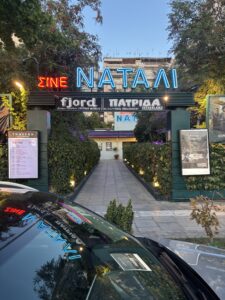
Fatherland is currently showing in UK cinemas. I was fortunate enough to see it a few months ago at an open-air cinema in Greece.
Fjord (Romania)
Fjord is my favourite of the five, and one of the best films I have seen in recent years. I desperately want it not only to receive a nomination for Best International Feature Film, but to win the award.
Although it automatically qualified under the category’s new rules as the winner of the 2026 Cannes Film Festival Palme d’Or, Fjord was also submitted as Romania’s official entry. This came as something of a surprise to me, given that the film is set in Norway and feels distinctly Norwegian. That said, it is a co-production involving Romania, France, Denmark, Finland, Norway and Sweden. Most of the dialogue is in English, but the film nevertheless meets the Academy’s eligibility requirements for non-English-language submissions. Norway, meanwhile, submitted Growth of the Soil.
Written and directed by Romanian filmmaker Cristian Mungiu, Fjord stars Romanian-American actor Sebastian Stan and Norwegian actress Renate Reinsve.
Reinsve previously starred in The Worst Person in the World, which was nominated for Best International Feature Film, and Sentimental Value, which became the first Norwegian film to win the award last year. Her performance in the latter also earned her a Best Actress nomination, although the award ultimately went to Jessie Buckley for Hamnet.
Stan and Reinsve play a married couple of devout evangelical Christians who have recently moved from Romania to Norway with their five children. When a teacher notices bruises on one of the children, she suspects abuse and reports the family to Child Services.
And the Oscar for Best International Feature Film goes to…
What I particularly liked about Fjord is its willingness to challenge some of the assumptions associated with what is considered politically correct in one of the world’s most progressive societies. It raises difficult questions about cultural differences, parental rights and the limits of state intervention. At what point does protecting a child become an intrusion into family life? And when does political correctness go too far?
It is a film that does not offer easy answers, and I found that particularly compelling.
It is probably too early to predict who will take home the Oscar, but I very much hope it will be Fjord.
Fjord is currently showing in UK cinemas. I was fortunate enough to see it during the summer at an open-air cinema in Greece.

La Bola Negra (Spain)
La Bola Negra was selected as Spain’s entry for Best International Feature Film at the 99th Academy Awards.
An ambitious queer epic inspired by an unfinished work by Spanish poet and playwright Federico García Lorca, the film moves between three different periods — 1932, 1937 and 2017 — exploring the connections between three gay men and Lorca’s work.
The film is in Spanish and is set primarily in Spain, although a couple of scenes take place in Athens. There, one of the protagonists researches queer dissidence in the music of Greek singer Rosa Eskenazi. I found these scenes interesting in their own right, although their connection to the rest of the narrative felt somewhat tenuous.
Spanish actress Penélope Cruz and American actress Glenn Close also appear in the film, albeit neither in a leading role.
La Bola Negra is currently showing in UK cinemas.
Possible Love (South Korea)
Possible Love is the latest film by Korean director Lee Chang-dong, whose previous film, Burning, was selected as South Korea’s entry for Best Foreign Language Film at the 91st Academy Awards. Although it did not receive a nomination, it became the first Korean film to make the final shortlist of nine.
Possible Love follows two married couples: one comprising a laid-off worker and his spouse, and the other a documentary filmmaker and her spouse. Like All of a Sudden, the film explores the impact of capitalism on working life, although it takes a rather different approach.
It also contains scenes of extreme police violence, which reminded me of Human Acts, the novel by Nobel Prize-winning Korean author Han Kang.
Possible Love was screened at both the 70th BFI London Film Festival and the London Korean Film Festival, which ran from 2 to 16 November 2026. It is currently available on Netflix.

Further reading
If you enjoyed this post, check out “9 films about mental illness“.
Alex
(the Traveling Psychiatrist)