9 things to do in Vienna
When I think of Vienna, three things immediately come to mind: classical music, psychotherapy, and coffee.
Every New Year’s Day, I enjoy watching the Vienna Philharmonic New Year’s Concert, broadcast live from the Golden Hall of the Musikverein. This year, the concert was conducted by the Canadian maestro Yannick Nézet-Séguin, marking his debut at the helm of this world-famous event. The programme featured an eclectic mix of traditional Strauss family waltzes alongside lesser-known works by composers such as Franz von Suppè, Josef Lanner, and Florence Price.
A few months later, in May 2026, I visited Vienna for another major musical event: the Eurovision Song Contest. In 2025, Eurovision had taken place in Basel, Switzerland, where Austria won with the song “Wasted Love”, performed by JJ. This year, Bulgaria won with the song “Bangaranga”. My personal favorites, however, were the Finnish “Liekinheitin” (6th place) and the Danish “Før vi går hjem” (7th place).
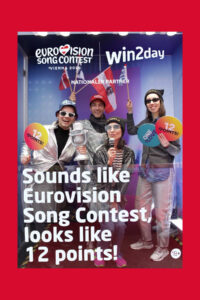
This was my fifth (proper) visit to the Austrian capital. Alongside Eurovision, I spent my time exploring beloved Viennese coffee houses and world-class museums.
Today, I am sharing my top nine recommendations for things to do in Vienna.
-
Go to a classical music concert
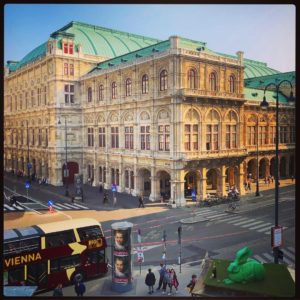
Opera and classical music have been integral to Viennese culture for centuries and remain central to the city’s identity. After all, Vienna is widely known as the Capital — or City — of Classical Music. A visit to the Vienna State Opera may be expensive, but it is certainly worthwhile. If you would prefer a more affordable option and do not mind standing, consider purchasing a standing-room ticket; these can be bought online or at the box office from 10 am on the day of the performance.
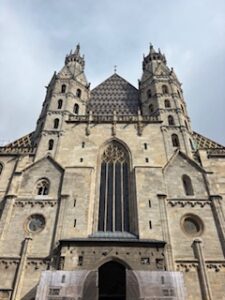
An excellent (and much more affordable) alternative to the Opera is attending a classical concert at St Peter’s Church (Peterskirche), a beautiful Baroque church located in the heart of Vienna, close to the famous St Stephen’s Cathedral (Stephansdom). Built in the early eighteenth century, Peterskirche provides the perfect backdrop for the music of Wolfgang Amadeus Mozart (concerts start at 8.30 pm; tickets from 39 euros).
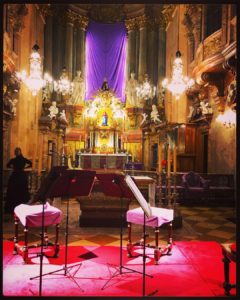
St Peter’s Church is not the only venue hosting classical music concerts. Another popular option is St Anne’s Church (Annakirche), situated very close to the Haus der Musik (concerts start at 8 pm; tickets from 33 euros).
2. Visit the Haus der Musik and the composers’ houses
The Haus der Musik
The Haus der Musik, located on Seilerstätte in the city centre, is an interactive museum dedicated to sound and music. The building, formerly known as the Palais of Archduke Charles, was once the residence of Otto Nicolai, composer of the opera *The Merry Wives of Windsor* and founder of the Vienna Philharmonic Orchestra.
Today, the first floor houses the Museum of the Vienna Philharmonic, while the second floor (Sonosphere) is dedicated to exploring and experiencing sound phenomena. The third floor focuses on the lives and works of legendary composers, including Joseph Haydn, Wolfgang Amadeus Mozart, Ludwig van Beethoven, Franz Schubert, Johann Strauss II, and Gustav Mahler. Last but not least, the fourth floor (virto|stage) offers a virtual stage experience resembling an opera house, where visitors can create their own personal musical and operatic performance (open daily from 10 am to 10 pm; general admission 19 euros vs night ticket 9.50 euros – after 8 pm).
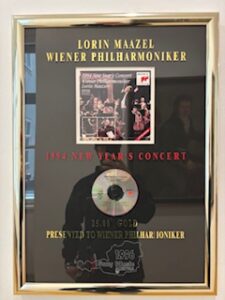
The composers’ houses
Although Wolfgang Amadeus Mozart was born in Salzburg, he spent most of his short adult life in Vienna. The apartment where he lived between 1784 and 1787, now known as Mozarthaus Vienna, is open to the public (open daily from 10 am to 7 pm; admission 16 euros). Located at Domgasse 5, just behind Stephansdom, this is where Mozart composed his famous opera “The Marriage of Figaro”.
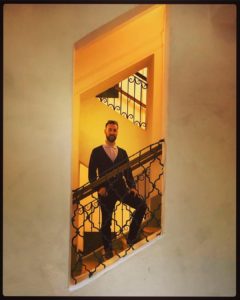
A combined ticket for Haus der Musik and Mozarthaus Vienna is available and costs 26 euros.
Mozart may be Austria’s most famous composer, but he is far from the only one associated with Vienna. Gustav Mahler, Joseph Haydn, Franz Schubert, and Johann Strauss II — composer of *The Blue Danube* waltz — were all Austrian, while the German-born Ludwig van Beethoven lived in Vienna from the age of 21 until his death.
In addition to Mozarthaus Vienna, visitors can also explore the Beethoven Pasqualati House (5 euros) and the Beethoven Museum (8 euros). Admission is free on the first Sunday of each month. The Beethoven Pasqualati House is located in the city centre, whereas the Beethoven Museum is situated on the outskirts of the city.
Other notable sites include the Haydn House, the Johann Strauss Apartment, Schubert’s Birthplace, and Schubert’s Final Residence, although these are currently temporarily closed.
3. Visit Schönbrunn Palace
Schönbrunn Palace is one of Vienna’s most magnificent historic landmarks, renowned for its grand Baroque architecture, beautifully landscaped gardens — which are free to enter — and rich imperial history.
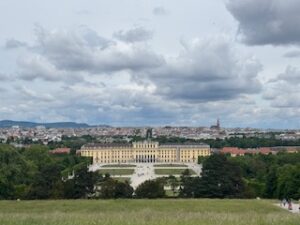
During the summer, the palace grounds host the celebrated open-air concerts of the Vienna Philharmonic, creating an unforgettable cultural experience that combines classical music with the splendour of Vienna’s royal heritage. The next one is due on 19 June 2026.
4. Visit Freud’s Museum
Sigmund Freud is probably one of the most famous figures ever to have lived in Vienna. The Sigmund Freud Museum, located at Berggasse 19, is where the Austrian neurologist and founder of psychoanalysis lived and worked for 47 years. As a psychiatrist myself, I found the museum particularly fascinating. Even setting my professional background aside, I would still highly recommend a visit (open from 10 am to 6 pm, closed on Tuesdays; admission 16 euros).
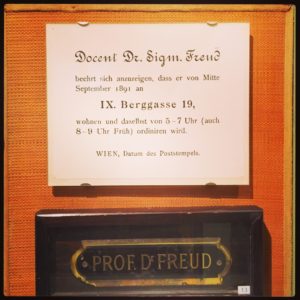
A combined ticket for the Sigmund Freud Museum and the Leopold Museum is available and costs 30 euros.
5. Visit Vienna’s art museums
The Albertina
The Albertina Museum and Art Gallery is home to the Batliner Collection, a permanent collection of classical modernist paintings featuring works by Pablo Picasso, Wassily Kandinsky, Claude Monet, Pierre-Auguste Renoir, Edgar Degas, Paul Cézanne, Henri de Toulouse-Lautrec, Georges Braque, and Henri Matisse. In addition to its permanent collection, the museum regularly hosts outstanding temporary exhibitions (open daily from 10 am to 6 pm, and until 9 pm on Wednesdays and Fridays; admission 20 euros).
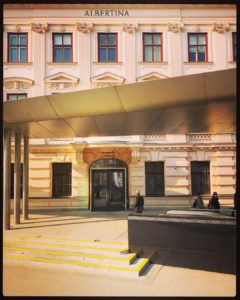
The Albertina can also be combined with a visit to the nearby Austrian Film Museum, a cinematheque where exhibitions take place on screen rather than in traditional gallery spaces (admission 10.50 euros). Alternatively, visitors can continue to the nearby Theatre Museum, which is currently temporarily closed.
Albertina Modern is a newer museum dedicated to modern and contemporary art, featuring works by internationally renowned artists such as KAWS, Jean-Michel Basquiat, Keith Haring, and Roy Lichtenstein (open daily from 10 am to 6 pm; admission 18 euros). The museum is housed within the historic Künstlerhaus building, whose upper level is home to the Künstlerhaus Association, the Society of Visual Artists of Austria.
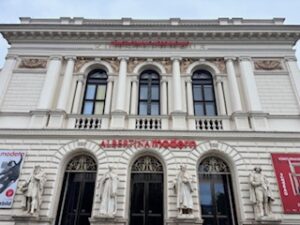
A combined ticket for the Albertina and Albertina Modern is available and costs 27 euros.
Belvedere
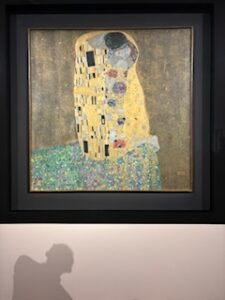
The magnificent Belvedere is one of Vienna’s most remarkable cultural landmarks, combining stunning Baroque architecture with an outstanding art collection. The museum is especially renowned for works by Gustav Klimt, including his famous masterpiece “Kiss (Lovers)”, as well as paintings by Claude Monet, Vincent van Gogh, Edvard Munch, and Oskar Kokoschka, making it a must-visit destination for art lovers (open daily from 9 am to 6 pm; admission 23 euros).
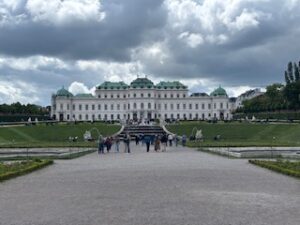
The Schloss Café Belvedere offers visitors a charming café experience within the grounds of the Belvedere Museum, combining elegant surroundings with traditional Viennese coffee, pastries, and beautiful views of the historic palace gardens.
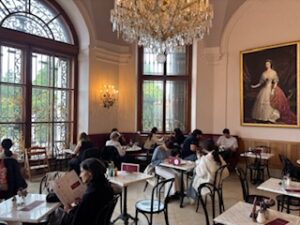
Hundertwasser Museum
Kunst Haus Wien, also known as the Hundertwasser Museum, is one of Vienna’s most visually distinctive cultural spaces, designed by artist and architect Friedensreich Hundertwasser. With its colourful façades, uneven floors, and organic forms, the museum reflects Hundertwasser’s unique artistic philosophy while showcasing his paintings, graphic works, and environmental ideas (open daily from 10 am to 6 pm; admission 16 euros). The museum café is also well worth a visit.
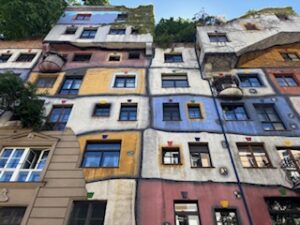
Just a short walk from the museum stands the Hundertwasserhaus (“Hundertwasser House”), a striking residential building designed by Hundertwasser himself. With its irregular lines, vibrant colours, and rooftop greenery, it remains one of Vienna’s most iconic examples of imaginative modern architecture.
MuseumsQuartier
MUMOK (Museum Moderner Kunst Stiftung Ludwig Wien) is Vienna’s leading museum of modern and contemporary art, located within the MuseumsQuartier. Its impressive collection includes works by artists such as Pablo Picasso, Andy Warhol, and Roy Lichtenstein, offering visitors an engaging exploration of twentieth- and twenty-first-century art movements (temporarily closed until 20 June; admission 18 euros).
The Leopold Museum is celebrated for its outstanding collection of Austrian modern art, particularly works associated with the Vienna Secession movement. The museum is especially famous for paintings by Egon Schiele and Gustav Klimt, offering visitors fascinating insight into Vienna’s vibrant artistic and cultural history (open from 10 am to 6 pm, closed on Tuesdays; admission 19 euros).
A combined ticket for MUMOK and the Leopold Museum is available and costs 33 euros.
Also located within the MuseumsQuartier area, the Museum of Art History (Kunsthistorisches Museum Wien) is one of Europe’s grandest art museums, renowned for both its magnificent architecture and extraordinary collections. The museum houses masterpieces by Peter Paul Rubens, Rembrandt, Diego Velázquez, and Johannes Vermeer, making it a treasure trove of classical European art (open from 10 am to 6 pm, until 9 pm on Thursdays, and closed on Mondays during winter; admission 22 euros).
Other museums
In addition to its renowned art museums, Vienna is home to many other museums that are equally worth visiting.
Located opposite the Museum of Art History, the Natural History Museum Vienna (Naturhistorisches Museum Wien) is one of Europe’s most important natural history museums, famous for its magnificent nineteenth-century architecture and extensive scientific collections. From dinosaur skeletons and meteorites to the renowned Venus of Willendorf, the museum offers a fascinating journey through the history of life and the natural world (open from 9 am to 6 pm, until 8 pm on Wednesdays, and closed on Tuesdays; admission 18 euros).
The Sisi Museum offers visitors an intimate glimpse into the life of Empress Elisabeth of Austria, affectionately known as Sisi. Located within the Hofburg Palace, the museum displays personal belongings, portraits, and historical artefacts that reveal both the glamour and the private struggles of one of Austria’s most iconic royal figures (open from 9 am to 5.30 pm; admission 20 euros).
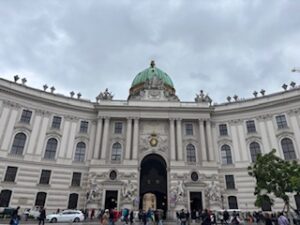
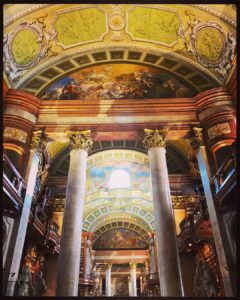
Also located within the Hofburg Palace is the State Hall of the Austrian National Library. This magnificent library dates back to the eighteenth century and houses around 200,000 books dating from 1501 to 1850. It is also home to 17 marble statues, while the statue of Emperor Charles VI stands proudly beneath the central dome, surrounded by four impressive Baroque globes (open from 9 am to 6 pm, closed on Mondays, and open until 9 pm on Thursdays; admission 12 euros).
6. Have coffee and cake at Vienna’s coffee houses
Vienna is undoubtedly the capital of coffee houses, and there is no better place to immerse yourself in the city’s rich café culture. Start with a Wiener Melange — an espresso topped with steamed milk and milk foam. Similar to a cappuccino, it typically contains less milk than its Italian counterpart. The Franziskaner (“Franciscan Monk”) is comparable to the Melange, except whipped cream replaces the milk foam. The Verlängerter resembles an Americano: espresso diluted with hot water, while the Einspänner consists of espresso with hot water topped with a generous dollop of whipped cream. My personal favourites, however, are the coffees with a touch of alcohol — whether Mozart liqueur, brandy, apricot liqueur, or orange liqueur, the latter known as Maria Theresia.
Café Central
Café Central is my favourite coffee house in Vienna. Unfortunately, it was temporarily closed during my most recent visit. On previous occasions, I enjoyed the “Sisi’s Favourite”, a delicious rum pastry with apricot jam.
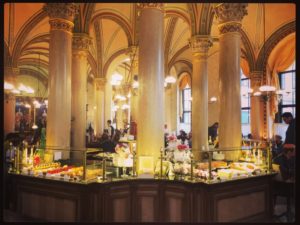
Café Sacher
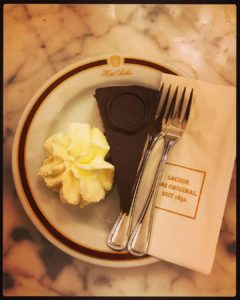
Café Sacher is another beautiful Viennese institution and the birthplace of the famous Sachertorte — a rich chocolate cake layered with apricot jam. The original recipe has remained a closely guarded secret since 1832 and is reportedly kept in a safe. The cake pairs perfectly with the Original Anna Sacher Kaffee, a single espresso with eggnog liqueur, served with milk foam. Located on the ground floor of Hotel Sacher, the café is open until midnight. Personally, I prefer visiting after an opera performance or dinner, when the queues are usually shorter, although the café also serves meals throughout the day.
Café Mozart
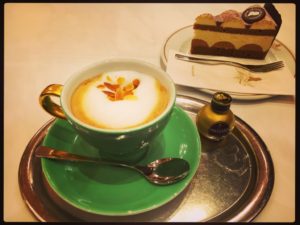
Just around the corner from Café Sacher, on Albertinaplatz, lies Café Mozart. This historic café is said to be where Graham Greene wrote *The Third Man*. During my visit, I tried the Mozarttorte — a wonderfully moist chocolate and pistachio cream tart — accompanied by a Mozart Kaffee, a double espresso with Mozart liqueur and whipped cream.
Café Demel
Nearby is another Viennese institution, Café Demel (open from 8 am to 7 pm). Established in 1786, Demel is almost as famous for its Sachertorte as Café Sacher itself.
Café Landtmann
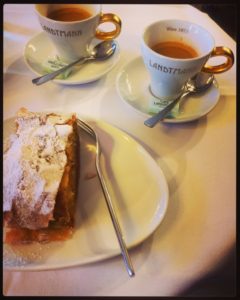
One of my favourite coffee houses in Vienna is Café Landtmann, an elegant café once frequented by Sigmund Freud, Gustav Mahler, and many other notable Viennese figures. Located on the Ringstraße since 1873, it is particularly renowned for its delicious Apfelstrudel.
Café Diglas
Café Diglas on Wollzeile — with additional branches on Fleischmarkt and at Schottenstift — is another of Vienna’s oldest and most traditional coffee houses.
In addition to its historic coffee houses, Vienna is also home to many charming modern cafés. During my recent trip, I spent time exploring the Neubau district, where I discovered several excellent speciality coffee spots. Among those I would particularly recommend are The Coffee Neubaugasse, Jonas Reindl Coffee Roasters, OTOTO Store & Specialty Coffee, and Coffee Photo Cluster.
7. Try Wiener Schnitzel and Mozartkugel
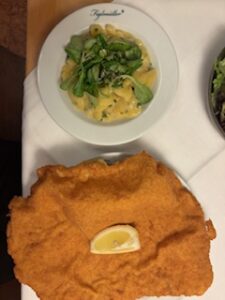
Wiener Schnitzel is a traditional Viennese dish consisting of a thin, breaded veal cutlet that is pan-fried until golden and crisp. It is considered one of Austria’s national dishes and is certainly worth trying during a visit to Vienna. Many restaurants are renowned for their schnitzel, including Figlmüller — often referred to as the “Home of the Schnitzel” — Plachuttas Gasthaus zur Oper, and Gasthaus “Zu den 3 Hacken”. Many traditional coffee houses also serve excellent schnitzel.
If, like me, you enjoy chocolate and marzipan, you may already be familiar with Mozartkugel (“Mozart balls”). Named after the Austrian composer, these delicious sweets are made from pistachio marzipan and nougat coated in dark chocolate. Traditionally wrapped in foil featuring Mozart’s portrait, Mozartkugeln are produced by several companies, including Mirabell, and make a perfect Viennese treat or souvenir.
8. Go on day trips from Vienna
Salzburg
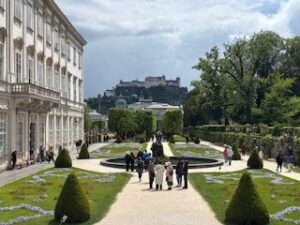
Salzburg is a beautiful city near the German border, located just over two hours from Vienna by train. It is famous for its Baroque architecture, as the birthplace of Wolfgang Amadeus Mozart, and as the setting for *The Sound of Music*. If you have an extra day during your stay, Salzburg is undoubtedly worth considering as a day trip.
Bratislava
Austria is bordered by a total of eight countries: Germany to the northwest, Czechia to the north, Slovakia to the northeast, Hungary to the east, Slovenia and Italy to the south, and Switzerland and Liechtenstein to the west.
Bratislava, the capital of Slovakia, lies uniquely at the crossroads of Austria, Slovakia, and Hungary. Vienna and Bratislava are only 50 kilometres apart, making them the closest pair of capital cities in Europe. Despite visiting Vienna many times and the journey taking less than an hour by train, I still have yet to visit Bratislava myself.
9. Go to music festivals in Burgenland
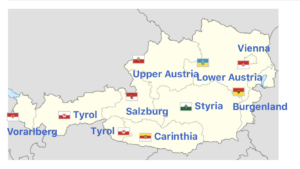
Austria is made up of nine federal states: Vienna, Lower Austria, Upper Austria, Styria, Tyrol, Carinthia, Salzburg, Vorarlberg, and Burgenland. The latter, Austria’s easternmost state, is home to several outstanding music festivals.
Lockenhaus Chamber Music Festival (8–18 July 2026)
The Lockenhaus Chamber Music Festival (Kammermusikfest Lockenhaus) takes place in the picturesque town of Lockenhaus, located in Burgenland near the Hungarian border. Lockenhaus lies approximately 115 km (a 1.5-hour drive) from Vienna and 250 km (around 2.5 hours by car) from Budapest. Interestingly, the town was part of Hungary until just over a century ago. Founded in 1981, the festival hosts concerts in the Church of Saint Nicholas (Pfarrkirche zum Heiligen Nikolaus) as well as in the town’s medieval castle, known as the Ritterburg or simply the Burg.
Seefestspiele Mörbisch (16 July – 22 August 2026)
The Mörbisch Lake Festival (Seefestspiele Mörbisch) is a renowned operetta festival held in Mörbisch am See, a town situated on the shores of Lake Neusiedl in Burgenland, close to the Hungarian border. Its spectacular stage is built directly on the lake and is considered the largest open-air operetta stage in the world.
Opera in the Quarry (15 July – 22 August 2026)
Opera in the Quarry (Oper im Steinbruch) is one of Austria’s most unique opera festivals. In 2026, Giacomo Puccini’s *Tosca* will be performed in the extraordinary setting of the first-century Sankt Margarethen Quarry. The town of Sankt Margarethen is located in Burgenland, near Eisenstadt and close to the Hungarian border.
Herbstgold Festival (16–26 September 2026)
Joseph Haydn was born in Rohrau, an Austrian village near the Slovak border. Although he spent most of his life in Vienna, he also lived in London for several years. Upon returning to Vienna, he settled in a suburban house now known as Haydnhaus (Haydn House), which today serves as a museum.
Haydn’s remains are buried in Eisenstadt, the capital of Burgenland, where he spent many summers. Today, Eisenstadt hosts the Herbstgold Festival, an annual classical music festival held at the magnificent Esterházy Palace.
If you cannot make it to Austria this summer, you may wish to consider the English Haydn Festival instead, taking place from 10 to 13 June 2026 in Bridgnorth, Shropshire.
Liszt Festival Raiding (16–25 October 2026)
Although Franz Liszt was born in the now Austrian town of Raiding, in Burgenland, he is generally regarded as Hungarian rather than Austrian. Indeed, he is probably Hungary’s most famous composer. The Liszt Festival Raiding takes place there in October.
Where to stay in Vienna
During my most recent visits to Vienna, I stayed in the following hotels, both of which I would happily recommend.
The Hoxton Vienna is centrally located, close to Wien Mitte and Belvedere Palace. Its eighth-floor bar offers beautiful panoramic views across the city, while during the summer months guests can also enjoy a rooftop pool.
Hotel am Brillantengrund is situated in Neubau, approximately one kilometre from the city centre. It is conveniently located near the MuseumsQuartier as well as the Wiener Stadthalle, where the Eurovision Song Contest took place. Neubau itself is a charming neighbourhood filled with stylish cafés, independent shops, and excellent public transport connections, including several nearby metro and tram stops.
How to get to Vienna
Austrian Airlines is one of my favourite European carriers. Offering passengers a complimentary Mozartkugel may seem like a small gesture, but it provides a delightful first taste of Austria before you even arrive.
From the airport, the quickest way to reach central Vienna is by train. The City Airport Train (CAT) is the fastest option, taking just 16 minutes to Wien Mitte, although it only runs every 30 minutes and is considerably more expensive than regional trains or the S-Bahn (12.45 euros one way; 14.90 euros return). Regional trains and the S-Bahn take approximately 20–25 minutes to Wien Mitte and cost just 5.20 euros.
Tips for saving money in Vienna
Vienna can be an expensive city, even by European capital standards. Aside from transport to and from the airport, there are several ways to reduce costs during your stay.
Public transport – A single journey on Vienna’s public transport network costs 3.20 euros. The flexible 7-Day Ticket costs 25.20 euros and is worth considering if you plan to use public transport frequently, particularly if you are staying outside the city centre or intend to visit attractions further afield. If you purchase the 7-Day Ticket, you only need to pay an additional 2.20 euros for the journey from the airport to the city centre when using regional trains or the S-Bahn.
Vienna City Card – The official Vienna City Card offers discounts on museums, attractions, cafés, and more (7-day card from 9 euros). Public transport can also be included (7-day card with transport from 39 euros).
Free admission – Admission to several composers’ houses is free on the first Sunday of each month.
Museum passes – A variety of museum passes are available, including the Vienna Pass, Vienna Flexi Pass, and Bundesmuseen Card. Prices start at approximately 100 euros, but these passes provide free — rather than discounted — admission to numerous museums and attractions. Their validity ranges from a single day (Vienna Pass) to a full year (Bundesmuseen Card).
Combined museum tickets – Standard museum admission in Vienna usually ranges between 15 and 25 euros. However, many museums offer discounted combined tickets. Examples include Haus der Musik and Mozarthaus Vienna (26 euros), Sigmund Freud Museum and Leopold Museum (30 euros), Albertina and Albertina Modern (27 euros), and MUMOK with the Leopold Museum (33 euros).
Choose the time – A late admission (night ticket) to the Haus der Musik costs half the regular price.
Top tip
Before arriving in Vienna, I would strongly recommend making a list of the museums and attractions you would most like to visit. Once you have an idea of your priorities, research the various ticket options and passes available in order to find the combination that suits your itinerary best.
Further reading
Check out my previous posts about Vienna and Austria.
Vienna: Music, Psychotherapy & Coffee
Vienna: Search for Meaning & the Mozart Effect
A classical music journey to Austria
6 Classical Music Festivals in Burgenland, Austria
Alex
(The Travelling Psychiatrist)