Hygge, Lagom & Lykke: 10 books about Scandi happiness

Denmark, Norway, Finland. According to the United Nations World Happiness Report that gets published every year, the Nordic countries are thought to be the happiest on Earth. Controversial as this may be, the Nordic countries do score highly on six key variables associated with happiness: income, healthy life expectancy, social support, freedom, trust and generosity. One may argue that it is the social welfare system in these countries that allows them to score so high and top the list of happiness. Yet, I think there may be something more… Could hygge be the answer? Or lagom perhaps?
The Scandinavian word ‘hygge’ has recently entered the English language. Defined as ‘the practice of creating cosy and congenial environments that promote emotional well-being’, hygge is regarded as a defining characteristic of Danish culture, even though the word actually originates from a Norwegian word meaning wellbeing.
Keen to learn more about it and to discover whether this is the secret to happiness, I bought a ticket to Norway (make sure you read my post ‘Fjords and Jazz: Norway in 9 days’). But first, I bought and read a number of books about hygge, lagom and happiness in Scandinavia.
Here are some of these books:
The Little Book of Hygge: The Danish Way to Live Well

Written by Meik Wiking, the CEO of the Happiness Research Institute in Copenhagen, this is probably the most archetypal book about hygge. Meik talks about different aspects of hygge, including light, togetherness and food, and even shares a few recipes.
ScandiKitchen: The Essence of Hygge
If you want more recipes, then this is probably the right book for you. Brontë Aurell is the Danish owner of London’s ScandiKitchen, the UK’s leading Scandinavian food outlets. Here she shares 30 sweet and savoury recipes, including recipes for a Danish dream cake, Swedish scones and Norwegian cream buns.
The Book of Hygge: The Danish Art of Living Well

This book by Louisa Thomsen Brits is the epitome of minimalism. Exploring the concept of hygge in just six chapters (belonging-shelter-comfort-wellbeing-simplicity-observance), it is minimalistic in the structure and the design (but thankfully not in the content).
The Art of Hygge: How to Bring Danish Cosiness Into Your Life

Written by Jonny Jackson and Elias Larsen, this is a DIY hygge book. It features not only delicious recipes, but also practical suggestions on how to make your home a bit more hyggelig. Standing out are the instructions on how to make pom-poms for beanie hats and woolly jackets for mugs.
Hygge: The Danish Art of Happiness

Written by Danish actress Marie Tourell Søderberg, this book may seem at first a cross between the previous two, as it is minimalistic as well as practical (and yes, it also includes recipes). However, Marie explores hygge from a personal viewpoint rather than that of an expert. And this is what sets it apart. It also features narratives and even dialogues (rather than just quotes) by a number of Marie’s colleagues and compatriots, such as actor Lars Mikkelsen and author Christina B. Kjeldsen.
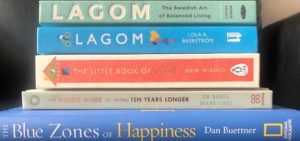
But, how about ‘lagom’? What is it and how different is it to hygge? The phrase ‘not too little, not too much, but just enough’ seems the best to describe this Swedish word. Here the emphasis lies on ‘just enough’ and ‘moderation’ and this appears to be the main Swedish tweak on the otherwise similar concept of hygge.
Lagom: The Swedish Art of Balanced Living

Linnea Dunne, a Swedish writer now living in Dublin, Ireland, writes about work-life balance and environmentally conscious living, both aspects of a lagom lifestyle. She shares tips on how to achieve it, as well as a few recipes ideal for the famous fika (coffee break the Swedish way).
Lagom: The Swedish Secret of Living Well

Lola Åkerström, a Nigerian writer and photographer who previously lived in America and now lives in Sweden, describes lagom as ‘a way of living that promotes happiness and celebrates fairness, moderation and being satisfied with what you’ve got’. In her book, Åkerström often compares and contrasts lagom to the Law of Jante, a set of ten rules that appears in Aksel Sandemose’s novel ‘A Fugitive Crosses His Tracks’.
The Little Book of Lykke: The Danish Search for the World’s Happiest People

Another book by Meik Wiking. Here he uses his Danish perspective to talk about a rather universal concept: happiness (lykke in Danish) and shares a number of happiness tips.
The Nordic Guide to Living 10 Years Longer: 10 Easy Tips to Live a Healthier, Happier Life

As the title suggests, Dr Bertil Marklund, a doctor and researcher at the Gothenburg University, shares ten tips that promise not only a happier but also a healthier life. He talks about the benefits of physical exercise (Tip 1: Movement Rejuvenates The Body), good sleep (Tip 3: Sleep Fortifies), sunlight exposure (Tip 4: Sun – but not too much), healthy diet (Tip 5: Eat yourself Healthy) and good oral health (Tip 8: Oral Health gives general Health). He shares tips on how to rip these benefits, but also strategies on combatting stress (Tip 2: Time for Recovery) and keeping weight in check (Tip 7: Keep your Weight in Check).
The Blue Zones of Happiness: Lessons from the World’s Happiest People

American author Dan Buettner takes the reader to some of the world’s statistically happiest countries: Costa Rica, Denmark and Singapore, and explores why people there are so happy. In the end, he also shares tips on how to be happier ourselves, based on lessons learned whilst talking to people from these countries.
Further reading
You may also be interested in reading my post ‘Sweden: Behind the myth of the lagom utopia’.
If you’d rather read Scandi crime novels, check out my post ‘Crime & Fjords: 9 Scandinavian writers you should read’.
To read about the Japanese concept of ikigai, check out my post ‘Ikigai & Komorebi: Finding purpose & beautiful moments’.
To follow my travels around the world, simply subscribe to the Traveling Psychiatrist (just click on the menu on the left hand side).
Happy reading!
Alex
(the Traveling Psychiatrist)
One Comment
Pingback: