13 (+1) anime films to watch
I had never been a fan of anime films — at least not until I visited Japan earlier this year. In Japan, the term anime refers to all forms of animated works, whether films or series, regardless of their country of origin. Outside Japan, however, it usually denotes Japanese animation specifically — and this is how I use the term in this post. Manga, on the other hand, refers to comics or graphic novels originating from Japan.
Known for its colourful artwork, distinctive character designs, and wide range of themes and genres — from action-packed adventures and heartwarming romances to thought-provoking dramas and futuristic sci-fi — anime films have become one of Japan’s most significant cultural exports, influencing art, fashion, and entertainment around the world. Unlike Western cartoons, which are often aimed primarily at children, anime frequently explores complex narratives and emotions, appealing to both younger and adult audiences alike.
Studio Ghibli is perhaps the most renowned Japanese animation studio. Founded in 1985 by directors Hayao Miyazaki and Isao Takahata, together with producer Toshio Suzuki, it has received international acclaim and numerous awards, including two Academy Awards for Best Animated Feature (Spirited Away and The Boy and the Heron). In total, six Studio Ghibli films have been nominated for the same award (Howl’s Moving Castle, The Wind Rises, The Tale of the Princess Kaguya, and When Marnie Was There among them). Additionally, The Red Turtle — an international co-production between Studio Ghibli and several French companies — was also nominated for Best Animated Feature at the 89th Academy Awards. Earlier works such as Pom Poko and Princess Mononoke were submitted as Japan’s official entries for Best Foreign Language Film at the 67th and 70th Academy Awards, respectively.
13 (+1) anime films to watch
In this post, I will discuss 13 (+1) anime films and 4 anime series — most of which are available to watch on Netflix. Anime films typically run for about two hours, while episodes of anime series usually last between 20 and 30 minutes.
My Neighbor Totoro (1988)
My Neighbor Totoro is one of the earliest Studio Ghibli anime films.
It tells the story of two young sisters who move to the countryside and befriend friendly forest spirits, including the gentle and iconic Totoro.
Totoro serves as the mascot for Studio Ghibli and is recognized as one of the most beloved characters in Japanese animation.
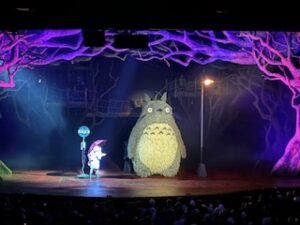
A stage adaptation of the film premiered in London in 2022 and ran at the Gillian Lynne Theatre until recently.
Princess Mononoke (1997)
One of the most successful Studio Ghibli anime films, Princess Mononoke is the ninth highest-grossing film in Japan. As already mentioned, it was Japan’s submission for Best Foreign Language Film at the 67th Academy Awards.
Set in a mythical past, it follows a young warrior caught in a conflict between humans and the gods of the forest, exploring the fragile balance between nature and industrialization.
Spirited Away (2001)
Spirited Away is also one of the most successful Studio Ghibli anime films. It is the third highest-grossing film in Japan, as well as the first to win the Academy Award for Best Animated Feature in 2002.
It tells the story of a young girl who becomes trapped in a mysterious spirit world and must find the courage to save her parents and return home.
The Cat Returns (2002)
The Cat Returns is another film animated by Studio Ghibli.
It follows a schoolgirl who saves a cat’s life and is whisked away to the fantastical Kingdom of Cats, where she must find a way to escape before turning into one herself.
Howl’s Moving Castle (2004)
Howl’s Moving Castle is another one of the most successful Studio Ghibli anime films. It is the tenth highest-grossing film in Japan and the second of the six Studio Ghibli anime films nominated for the Academy Award for Best Animated Feature.
The story follows a young woman cursed with old age who seeks the help of a reclusive wizard and becomes entangled in his magical, moving castle and a brewing war.
The Wind Rises (2013)
Released almost a decade later, The Wind Rises is the third of the six Studio Ghibli anime films that have been nominated for the Academy Award for Best Animated Feature.
It depicts the life of Jiro Horikoshi, the visionary engineer who designed Japan’s World War II fighter planes, blending dreams, love, and the burden of innovation.
The Tale of the Princess Kaguya (2013)
Also released in 2013, The Tale of the Princess Kaguya is the fourth of the six Studio Ghibli anime films that have been nominated for the Academy Award for Best Animated Feature.
Based on a Japanese folktale, it tells the story of a mysterious girl found inside a bamboo stalk who grows into a radiant young woman torn between earthly love and celestial destiny.
When Marnie Was There (2014)
Released a year later, When Marnie Was There is the fifth of the six Studio Ghibli anime films that have been nominated for the Academy Award for Best Animated Feature.
It follows a lonely girl who befriends a mysterious blonde girl named Marnie, only to discover that their connection transcends time and memory.
Your Name (2016)
Your Name is one of the most successful anime films, though not from Studio Ghibli. It is the sixth highest-grossing film in Japan. Written and directed by Makoto Shinkai, it is the first instalment of what critics call Shinkai’s “disaster trilogy,” which reflects the recurring theme of natural calamities in Japan. It is also one of my favourite anime films.
The story follows two teenagers who mysteriously begin switching bodies and must uncover the truth behind their connection before tragedy strikes.
Weathering With You (2019)
Weathering With You was Japan’s submission for Best Foreign Language Film at the 92nd Academy Awards. It is the second instalment of Makoto Shinkai’s “disaster trilogy,” following Your Name (2016) and preceding Suzume (2022).
It tells the story of a runaway boy who meets a girl capable of controlling the weather, as together they grapple with love, sacrifice, and the forces of nature.
Suzume (2022)
Suzume is the third and final instalment of Makoto Shinkai’s “disaster trilogy,” following Your Name (2016) and Weathering With You (2019).
It follows a teenage girl who embarks on a journey across Japan to close magical doors that unleash natural disasters, finding healing and purpose along the way.
Blind Willow, Sleeping Woman (2022)
Unlike the rest of the anime films on this list, Blind Willow, Sleeping Woman is not Japanese. However, it is set in Tokyo shortly after the 2011 Tōhoku earthquake and tsunami. Perhaps more importantly, it adapts six short stories from three collections by Japanese author Haruki Murakami (Blind Willow, Sleeping Woman, The Elephant Vanishes, and After the Quake).
It interweaves surreal and introspective vignettes of ordinary people confronting loss, alienation, and the mysterious rhythms of life.
The Boy and the Heron (2023)
One of the latest Studio Ghibli anime films, The Boy and the Heron was the second to win the Academy Award for Best Animated Feature in 2023.
It tells the story of a boy grieving his mother’s death who discovers a magical world of life and death after following a talking heron.
Blue Giant (2023)
Blue Giant is another one of my favourite anime films. It is based on the manga series of the same name. The soundtrack is by Japanese jazz composer and pianist Hiromi Uehara. Although it is not available on Netflix UK, it is available on Netflix US.
It follows a high school student who discovers a passion for jazz saxophone and dreams of becoming one of the greatest musicians in the world.
4 anime series to watch
Cowboy Bebop (1998)
Cowboy Bebop is a 26-episode series that aired from 1998 to 1999. It was one of the first anime series directed by Shinichirō Watanabe.
Set in the year 2071, it follows a group of bounty hunters traveling through space aboard the spaceship Bebop, chasing criminals while confronting their own haunted pasts.
I personally enjoyed the soundtrack more than the series; the music was composed by Yoko Kanno and features a distinctive and energetic jazz score.
An anime film set between episodes 22 and 23 of the series, titled Cowboy Bebop: The Movie, was released in 2001 and also directed by Shinichirō Watanabe.
In the same year, an American live-action, ten-episode adaptation was also released.
Carole & Tuesday (2019)
Carole & Tuesday is a 24-episode anime series, also directed by Shinichirō Watanabe.
Set on a colonized Mars, it tells the story of two young women from different backgrounds who come together to create music in a society dominated by artificial intelligence.
I enjoyed it much more than Cowboy Bebop.
Exception (2022)
Exception is an eight-episode anime series.
Set in deep space, it follows a crew of 3D-printed humans on a mission to terraform a distant planet, only to face a terrifying crisis when one of their own is misprinted.
The music was composed by Japanese composer Ryuichi Sakamoto, which was the main reason I watched Exception in the first place — and also what I enjoyed the most.
Lazarus (2025)
Lazarus is the most recent anime series directed by Shinichirō Watanabe. It consists of 13 episodes.
Set in the late 21st century, it follows a special agent tasked with saving humanity after a miracle drug that eliminates sleep turns deadly.
Once again, I found myself enjoying the soundtrack more than the series itself; it features music by Kamasi Washington, Bonobo, and Floating Points.
1 Short Anime Film to Watch
She and Her Cat (1999)
She and Her Cat is a short anime film directed by Makoto Shinkai, lasting only five minutes.
Told from the perspective of a cat, it depicts the quiet, tender relationship between the animal and his owner as they navigate life’s emotional seasons together.
A slightly longer adaptation, titled She and Her Cat: Everything Flows, was released in 2016.
This half-hour version expands on the original, following a young woman who moves to the city with her cat and gradually learns to face loneliness and independence.
More recently, in 2022, the story was adapted into a novel by Shinkai together with Naruki Nagakawa.
Further reading
If you’d rather watch live-action films (either Japanese or set in Japan), check out my recently published posts:
10 (+1) Japanese Films to Watch
6 Non-Japanese Films Set in Japan
Alex
(the Traveling Psychiatrist)